Royal Front Hand Mehndi Designs: Simple and Stylish Henna Ideas for 2026
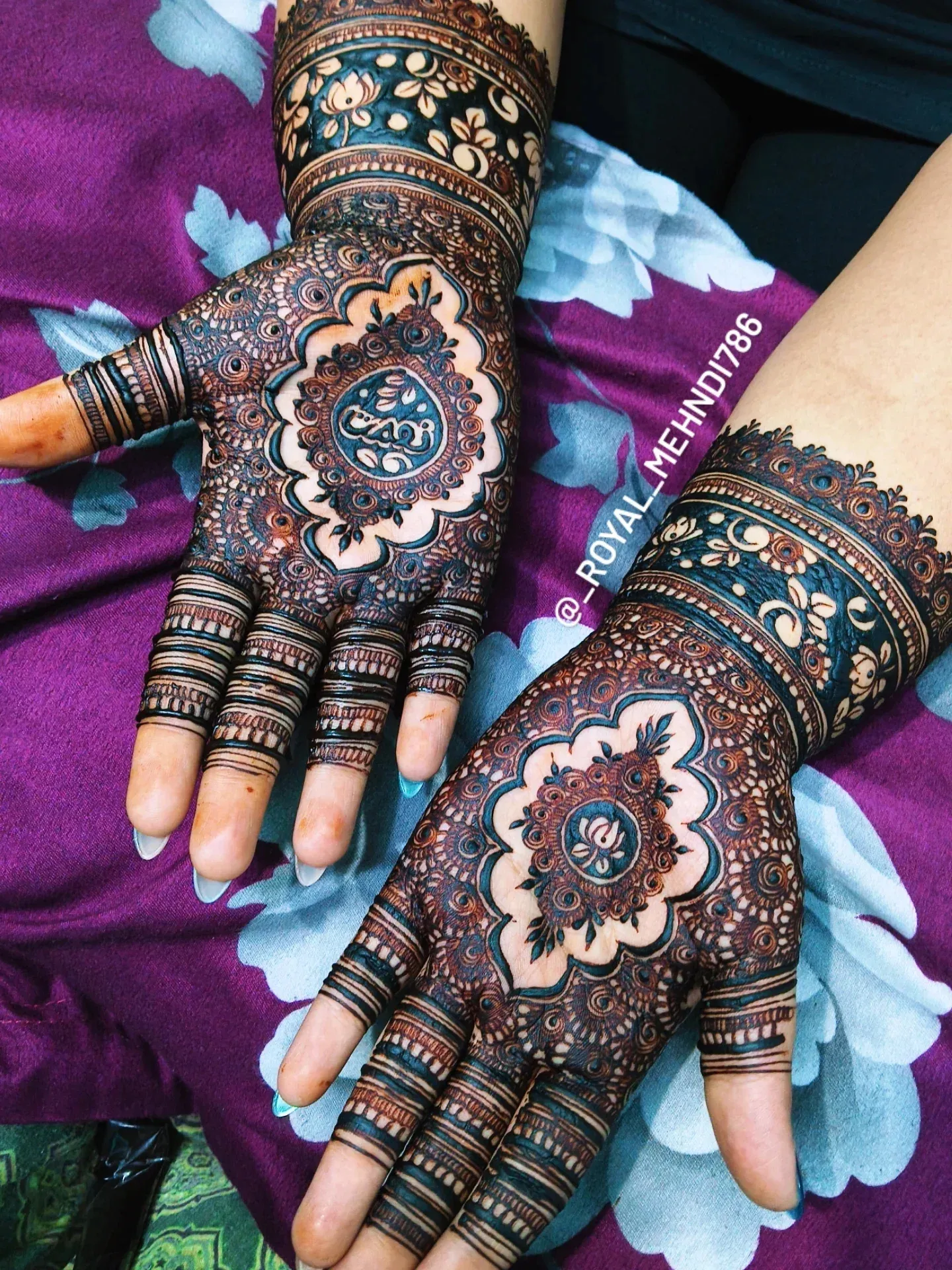
Front hand mehndi covers a wide range, from a few clean strokes to a fully detailed palm. A royal front hand mehndi design sits at the detailed end of that spectrum. Think of a central peacock, lotus motifs, fine net shading (jaali), and clean negative space, rather than scattered flowers filling every inch. A simple front hand mehndi design uses the same motifs with less coverage: one motif, a thin trail (bel), or a bare wrist band. Both come from the same design language the difference is density, not a different style altogether.
The word “royal” traces back to Mughal and Rajput court art, where balance, symmetry, and architectural precision mattered as much as beauty.
This guide covers both ends of that spectrum. You’ll find dense bridal designs alongside simple, minimal front hand options, plus advice on which motifs suit weddings, Eid, or engagements. You’ll also find practical, science-backed steps for aftercare. According to global celebrity henna masters like Pavan Dhanjal and Ash Kumar, along with stain oxidation science, achieving a rich, dark maroon stain requires letting the natural lawsone dye bond with your skin for 6–12 hours while keeping it warm and away from water.
Whether you’re booking a professional artist or drawing it yourself, this guide covers everything you need to know before you start.
Most Importantly: This guide ensures your safety by helping you identify and avoid harmful “black henna.” The U.S. Food and Drug Administration (FDA) strongly warns against black henna temporary tattoos because they illegally contain p-phenylenediamine (PPD). As documented in PubMed (National Institutes of Health), PPD is a potent chemical sensitizer that can trigger severe allergic contact dermatitis, painful blistering, and lifelong chemical sensitivities or permanent scarring.
Editor’s Note: Simplemehandidesigns.com shares beautiful mehndi inspiration for weddings, festivals, celebrations, and everyday occasions. We feature designs sourced from real mehndi artists and provide credit or a source link whenever available. We do not use AI-generated mehndi images or rely on anonymous, unverifiable sources. Our team reviews the artist or original source before featuring a design. Some links may be affiliate links, at no extra cost to you.
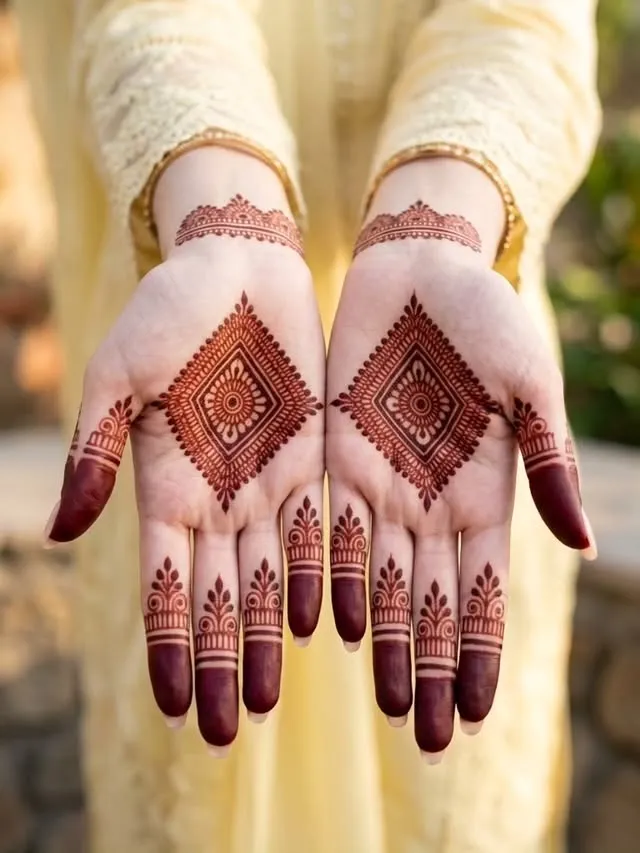
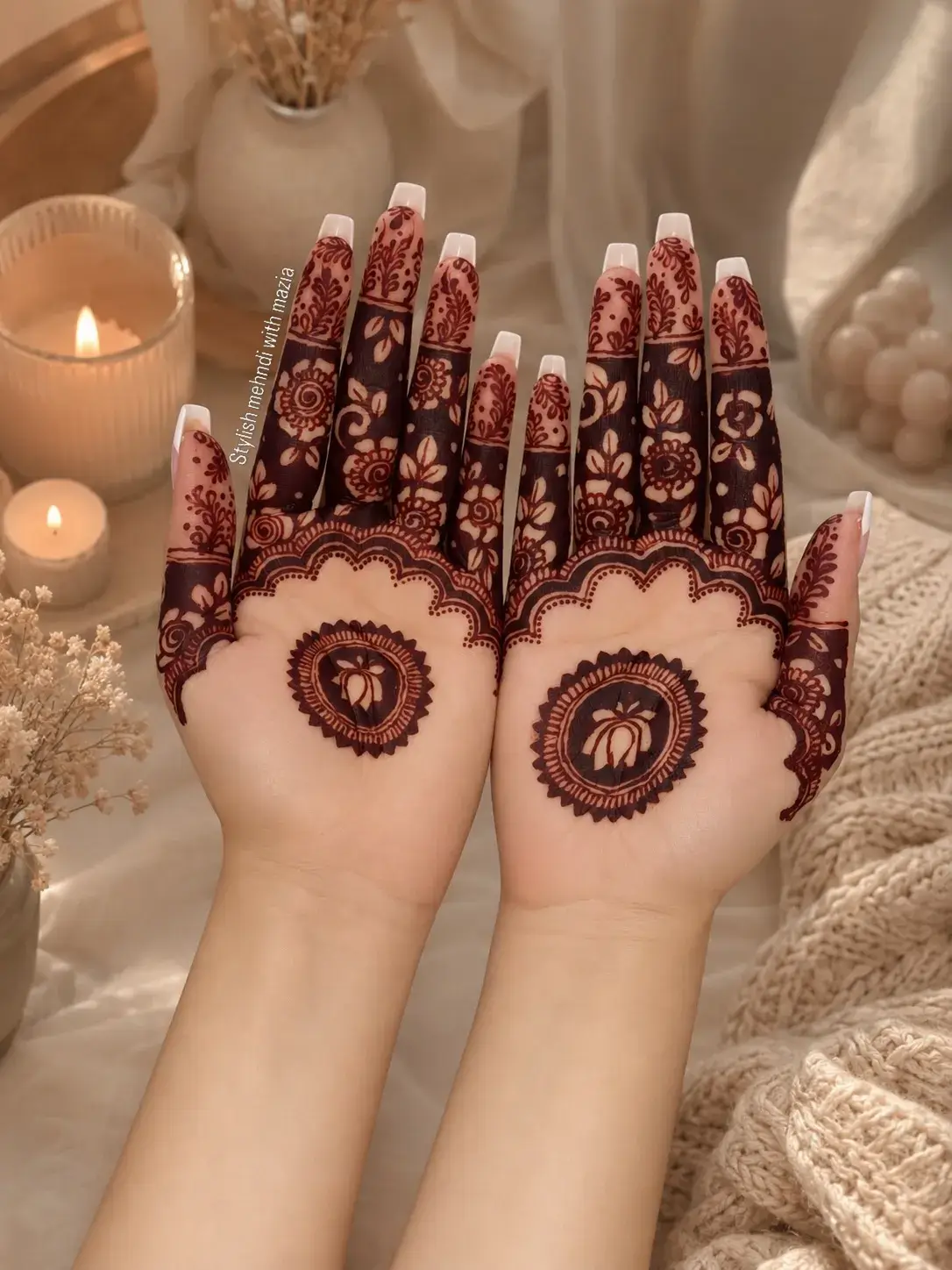
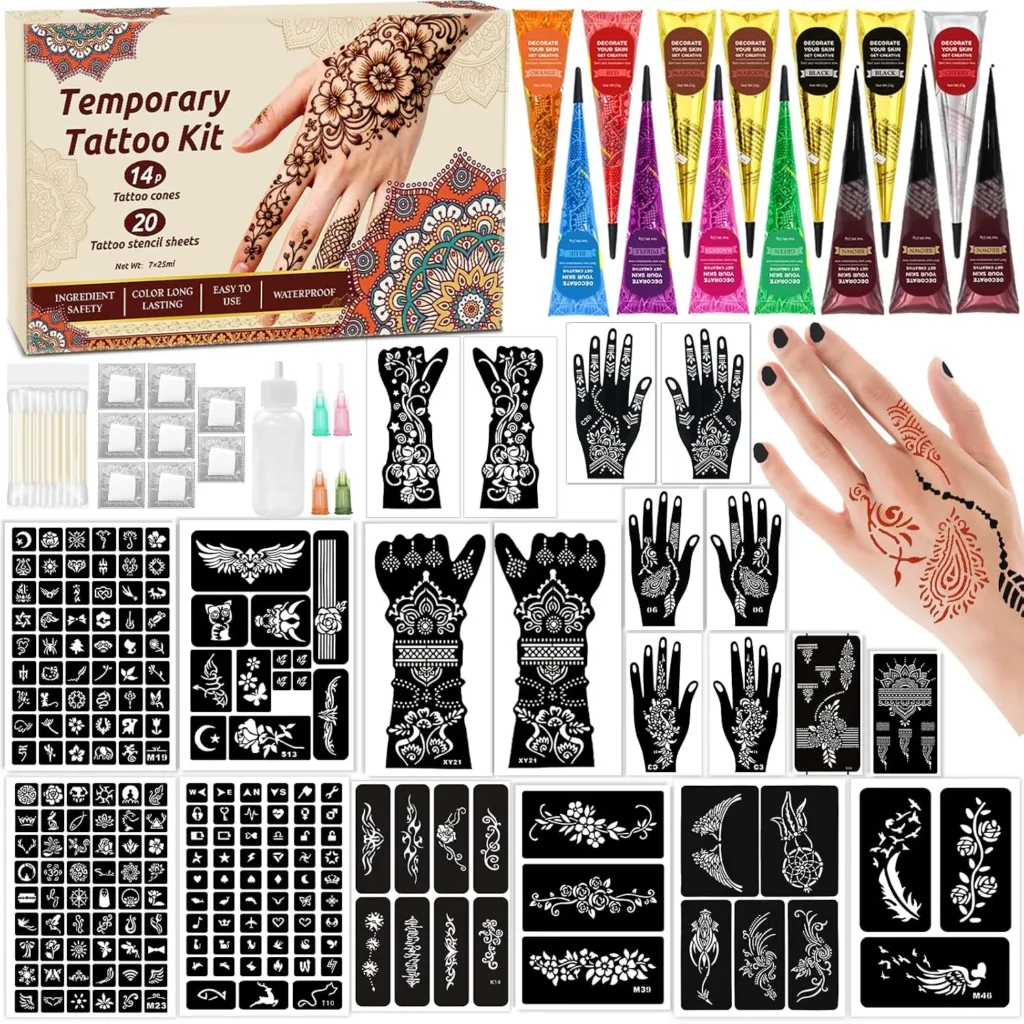
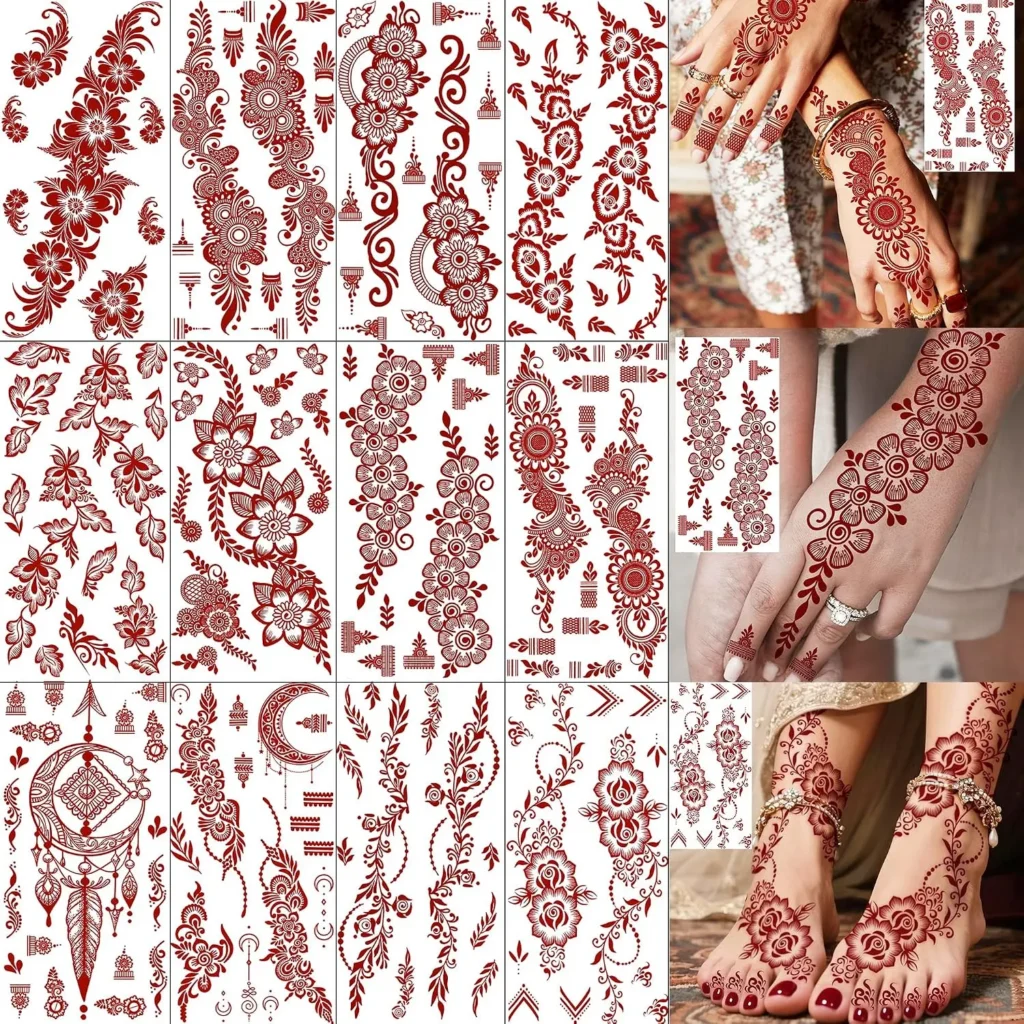
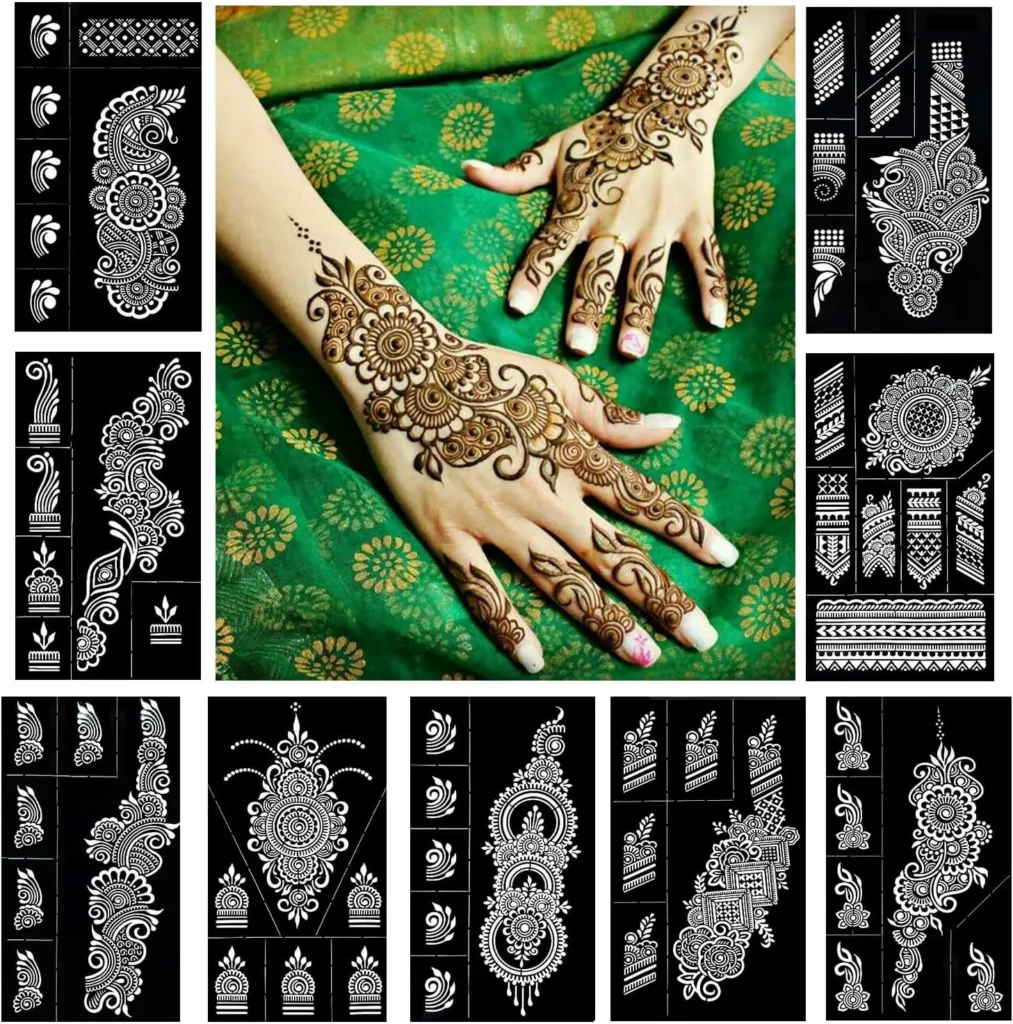
My Favourite Mehndi Stickers: These are some of my favourite mehndi stickers that I personally love using. I’ve picked these designs because I love how they look and how easy they are to use. Check out my top picks below!
Peacock Motif Royal Front Hand Mehndi Designs
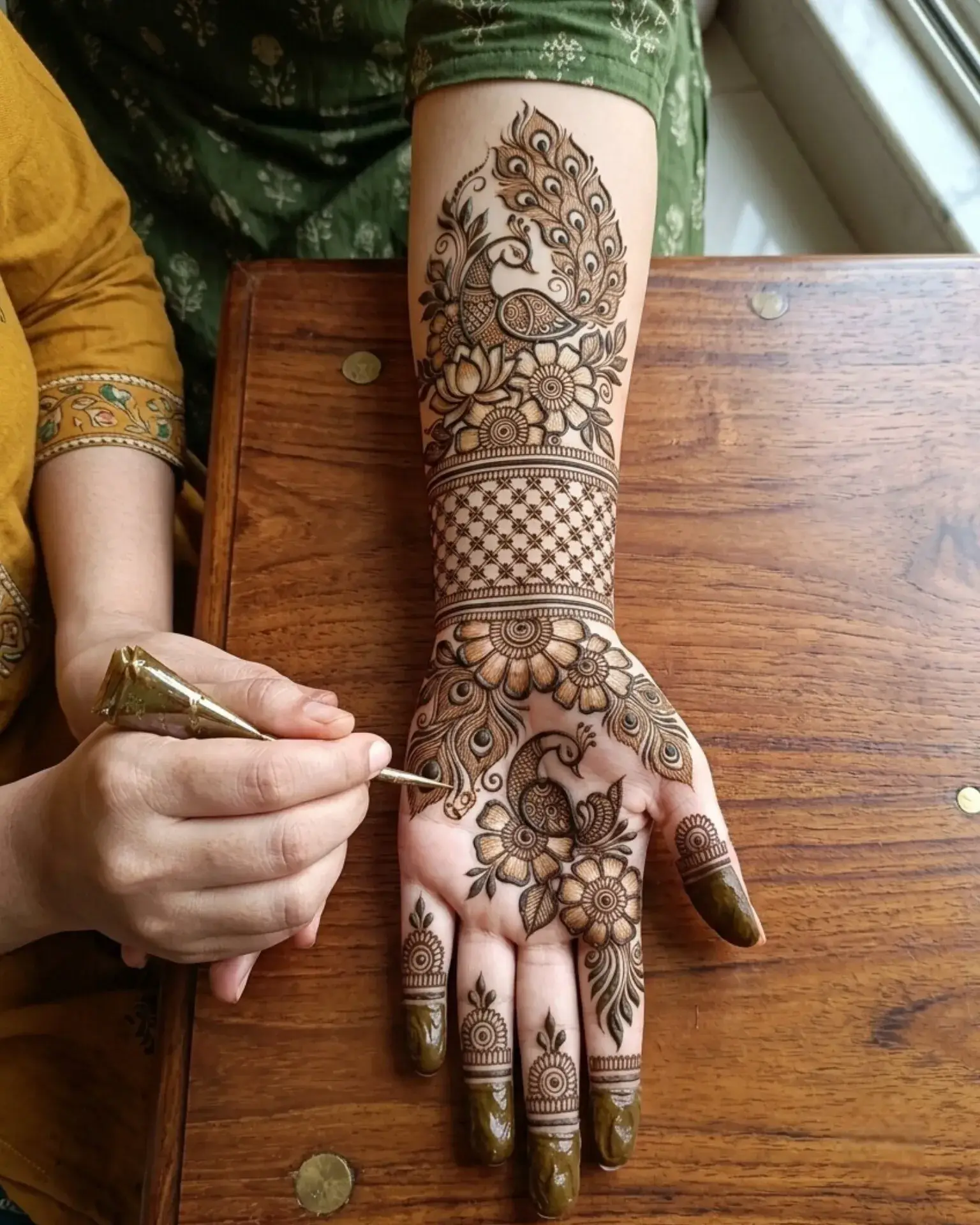
The peacock is the most requested royal motif, and for good reason. Its curved neck and layered feathers give artists room to show real skill, and its meaning of grace and beauty fits bridal work naturally.
Classic Peacock Centerpiece Design
A single peacock sits at the center of the palm, tail feathers fanning out toward the fingers. Fine jaali fills the feather details, while the space around the bird stays mostly bare. Works well as a standalone design for engagements or smaller functions.
Twin Peacock Symmetry Design
Two peacocks face each other across the palm, usually meeting at a central mandala or medallion. The mirrored layout takes more planning than a single-bird design, but it reads as more formal, making it a strong choice for the main wedding day.
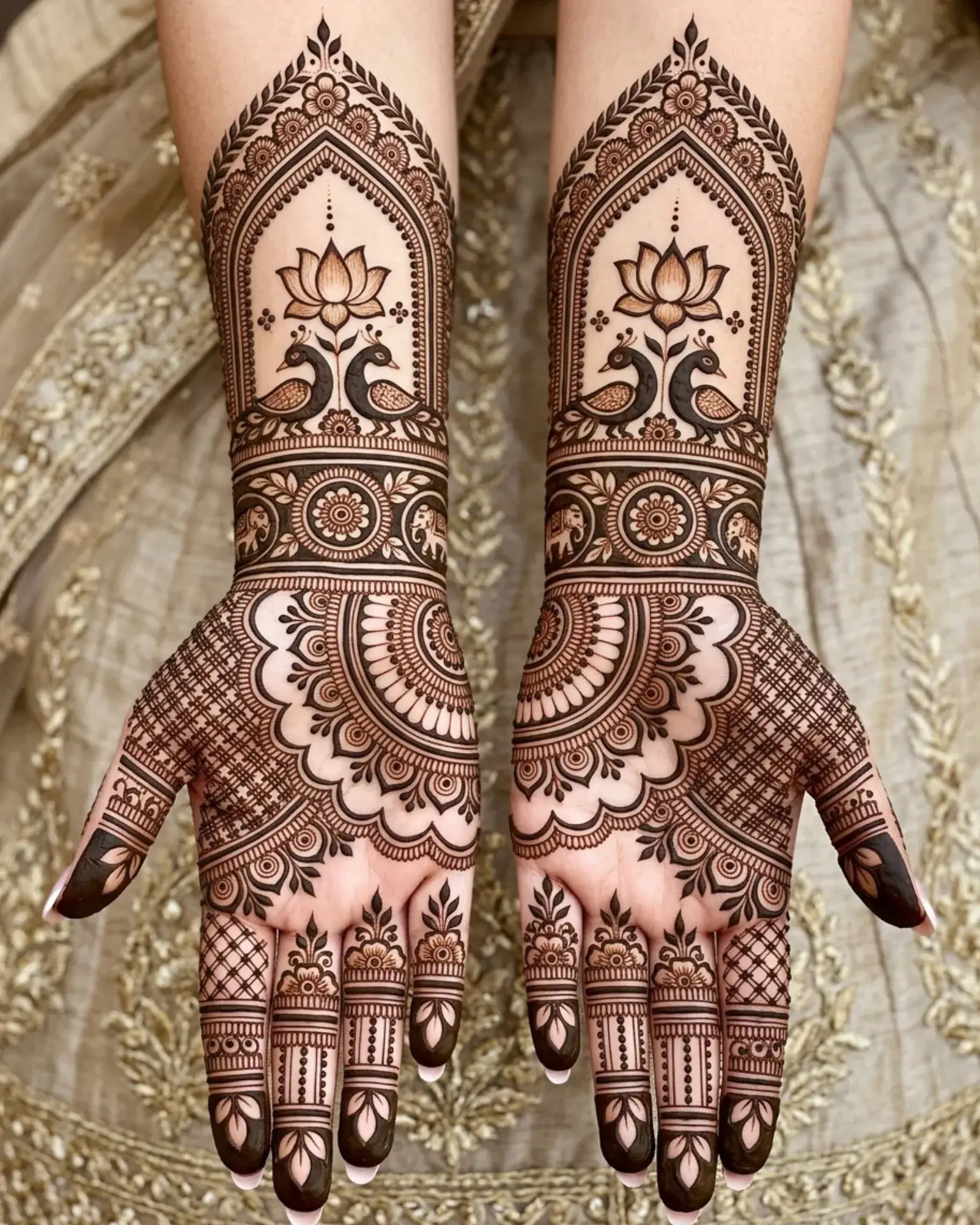
Peacock with Lotus Feather Fill
Here, each peacock feather ends in a small lotus instead of a plain teardrop. It’s a heavier design, better suited to bridal ceremonies, and it pairs two of the most common royal motifs without looking crowded if the artist keeps the spacing even.
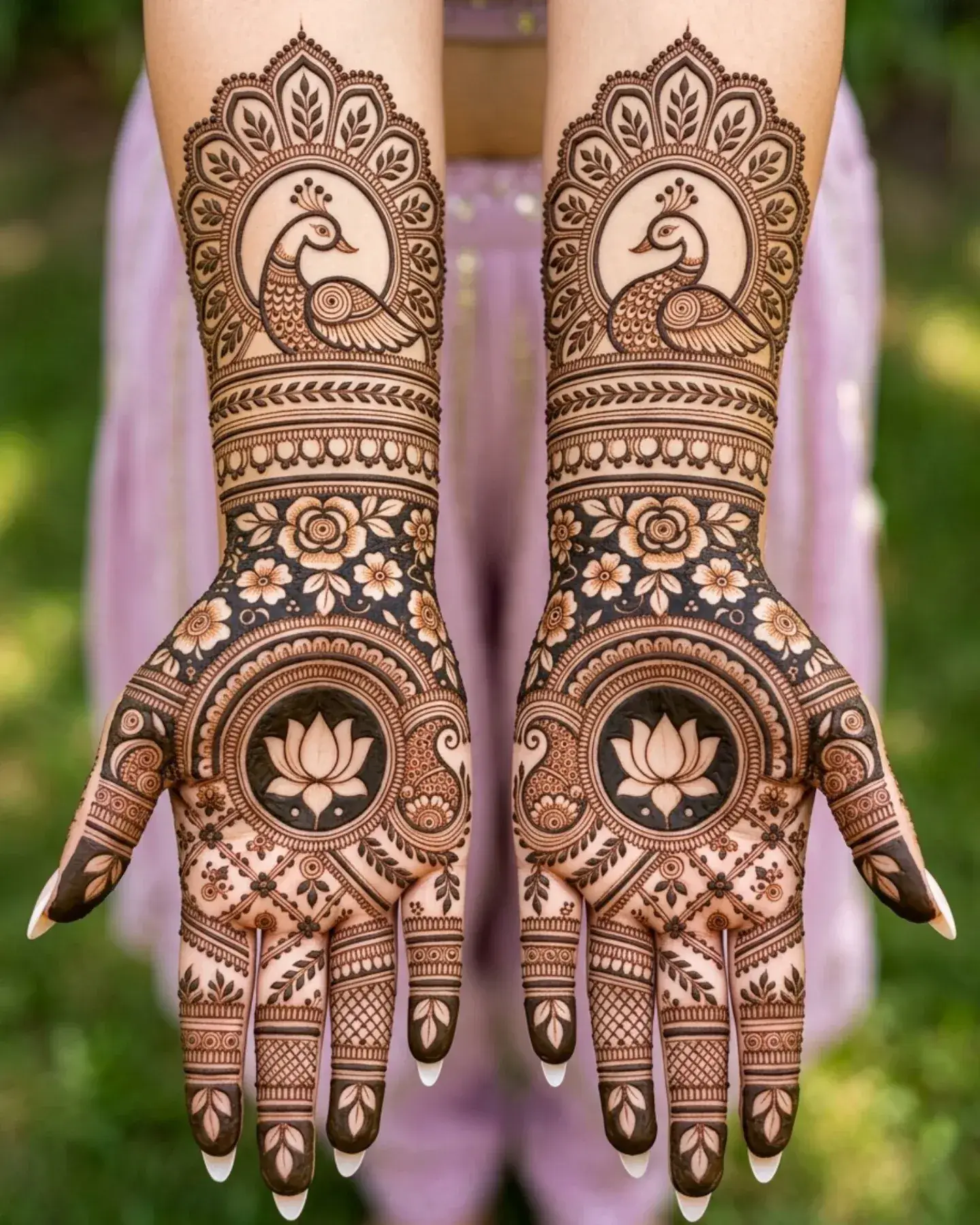
Peacock and Jhumka Pairing
A peacock sits above a row of jhumka, the small bell-shaped earring motif, hanging from the wrist. This design leans into the jewelry-inspired side of royal mehndi and suits brides who want the design to double as an ornament.
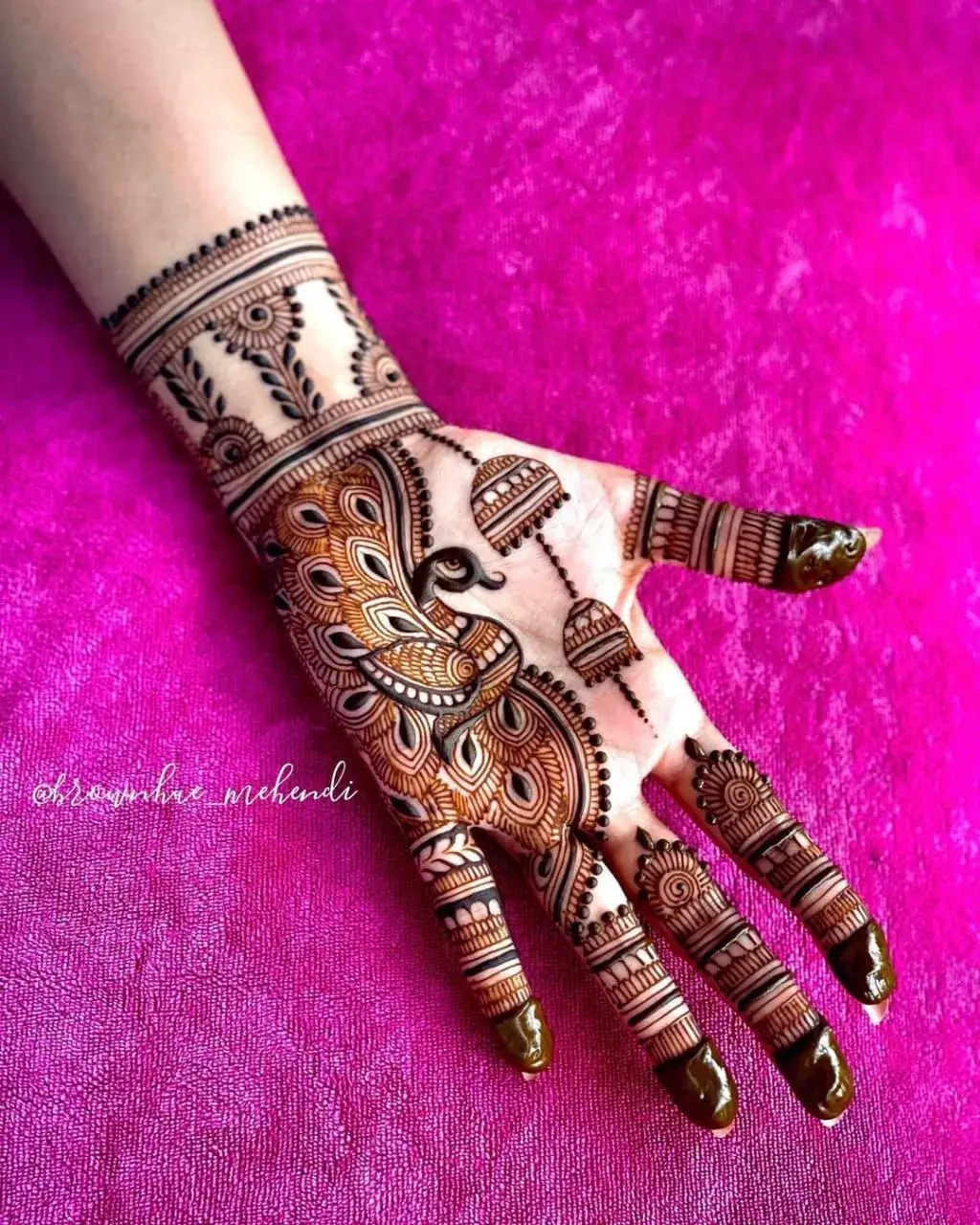
Minimal Peacock Outline Design
Just the outline of a peacock, without dense feather fill or heavy shading. This keeps the negative space element front and center. A good fit for anyone who wants the peacock’s symbolism without the multi-hour application time.
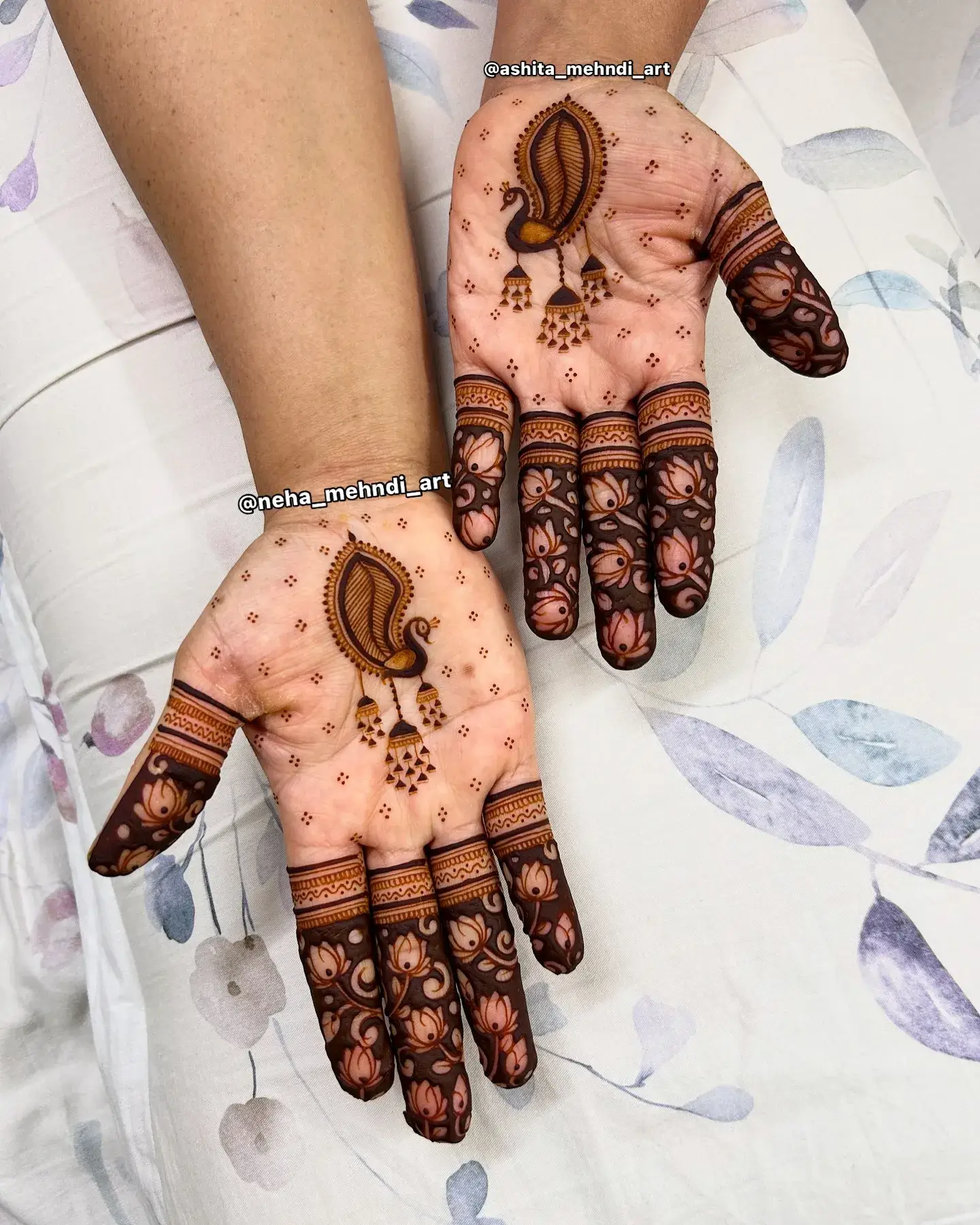
Lotus and Pichwai-Inspired Simple Mehndi Designs
The lotus is the other motif that shows up across almost every mehndi tradition. In its simple form, it needs far less detailing than a peacock, which makes it a favorite for beginners and quick festive designs.
Central Lotus Medallion Design
One lotus sits in the middle of the palm, drawn as a rounded medallion with a few petal layers. The rest of the hand stays bare, or gets a light trail toward one or two fingers. Easy to draw and hard to get wrong.
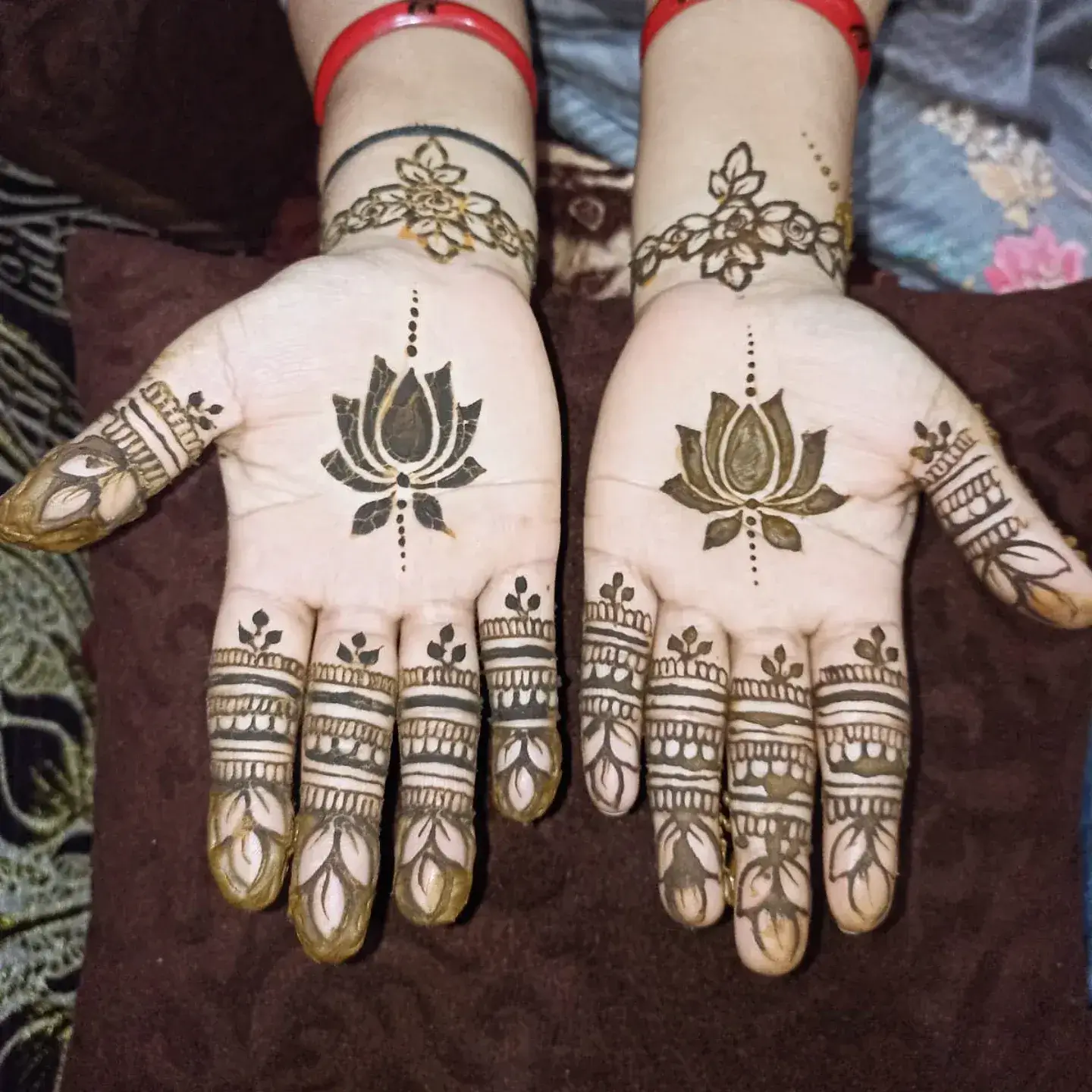
Negative-Space Lotus Design
Only the outline of the lotus is filled in, & the petals themselves are left blank. The contrast between the dark outline & bare skin does most of the visual work here. This is one of the quickest lotus mehndi designs to apply.
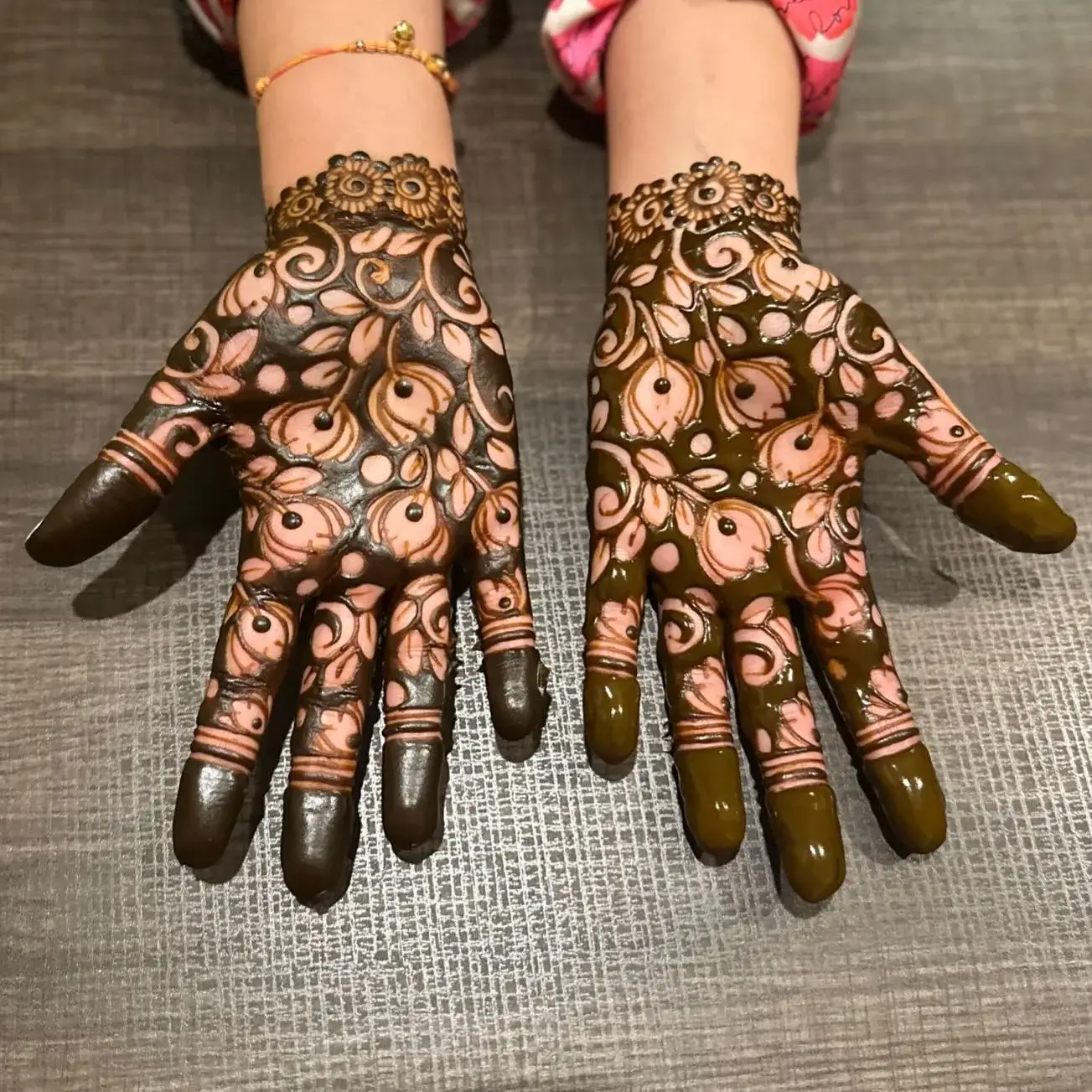
Lotus and Vine Trail Design
A single lotus connects to a thin vine that runs toward the wrist or one finger. It adds a bit of movement to the design without turning it into a dense, royal-style piece.
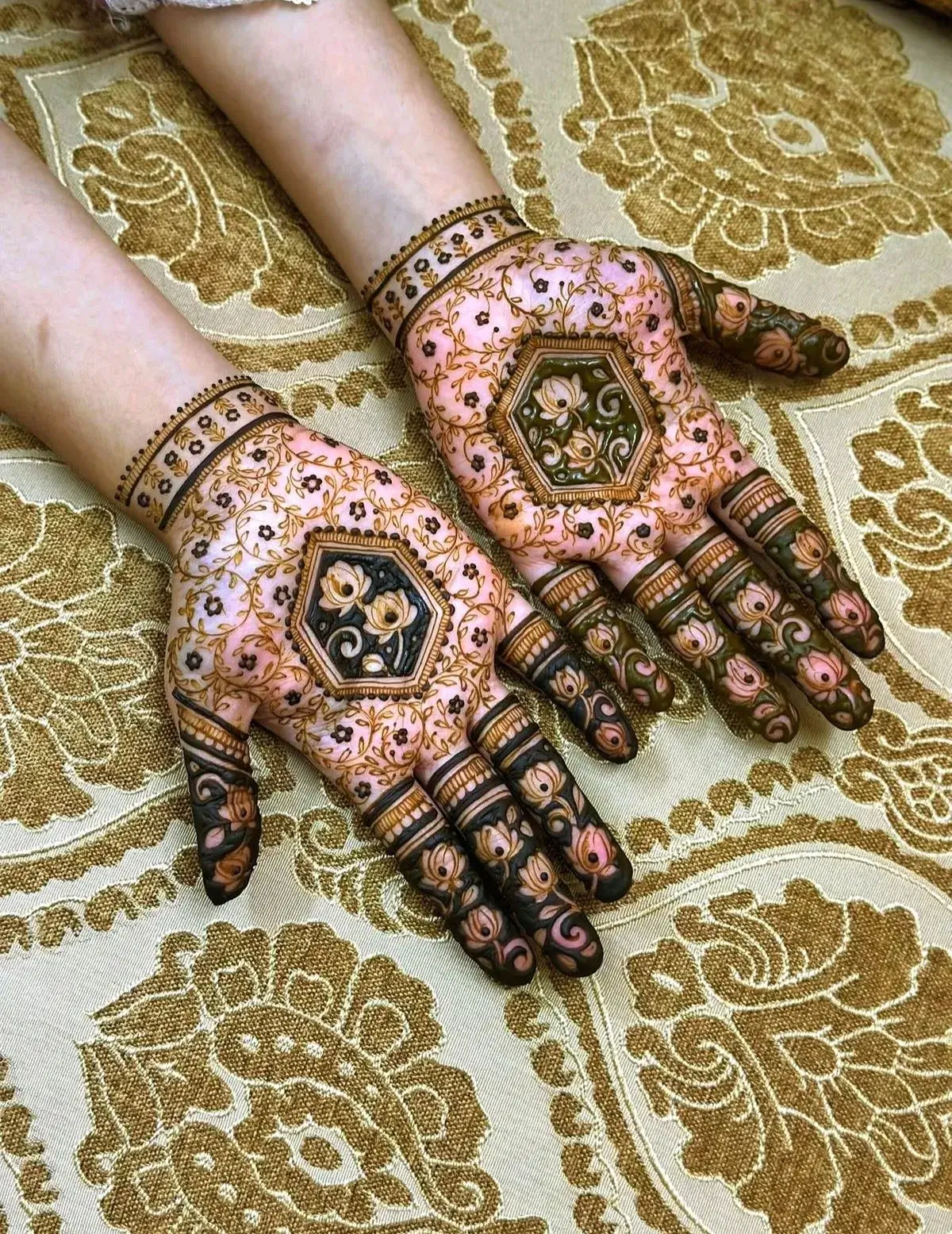
Layered Lotus Petal Fill Design
The lotus petals are shaded in layers, dark near the center and lighter toward the edges. This adds depth without adding new motifs, so it still counts as a simple design even though it looks more finished.
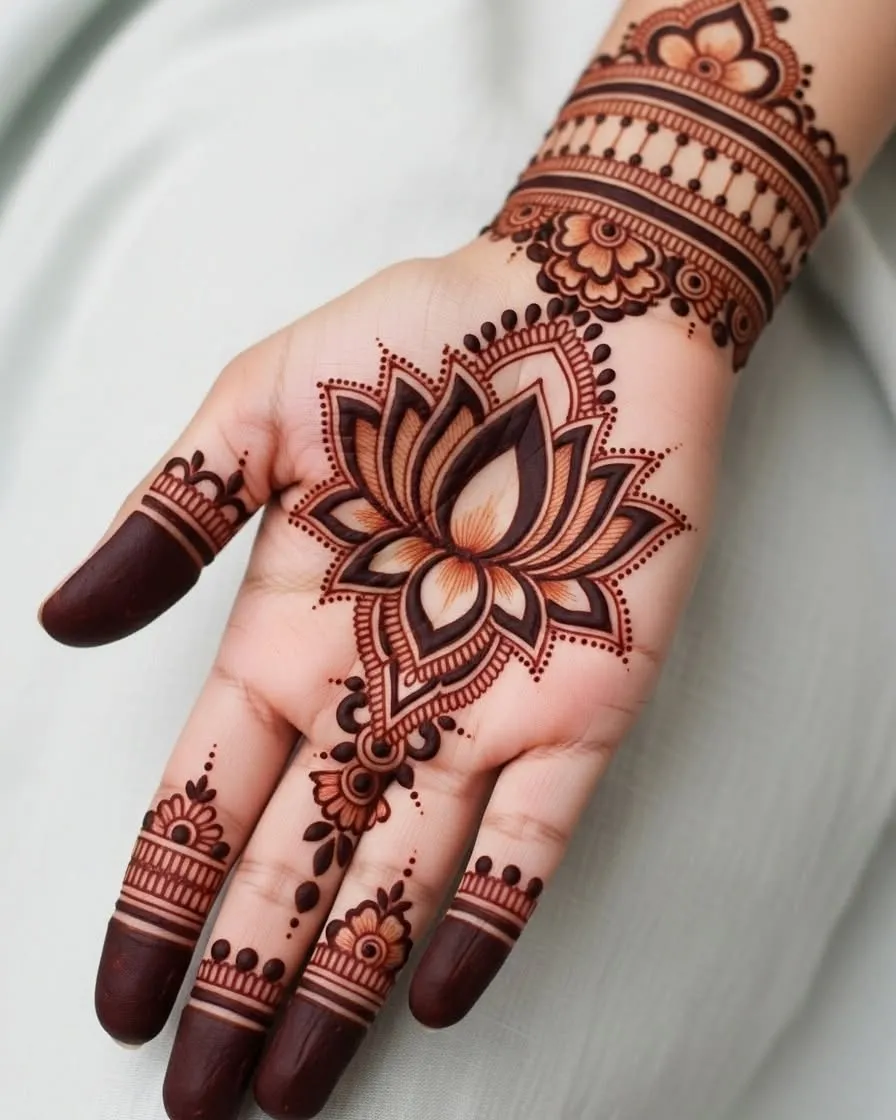
Pichwai-Style Lotus Border Design
Inspired by Pichwai temple paintings, this style frames the lotus with a heavier outer border and fine internal vein lines instead of solid fill. It takes a little more care than the other lotus designs here, but it still stays within simple, single-motif territory.
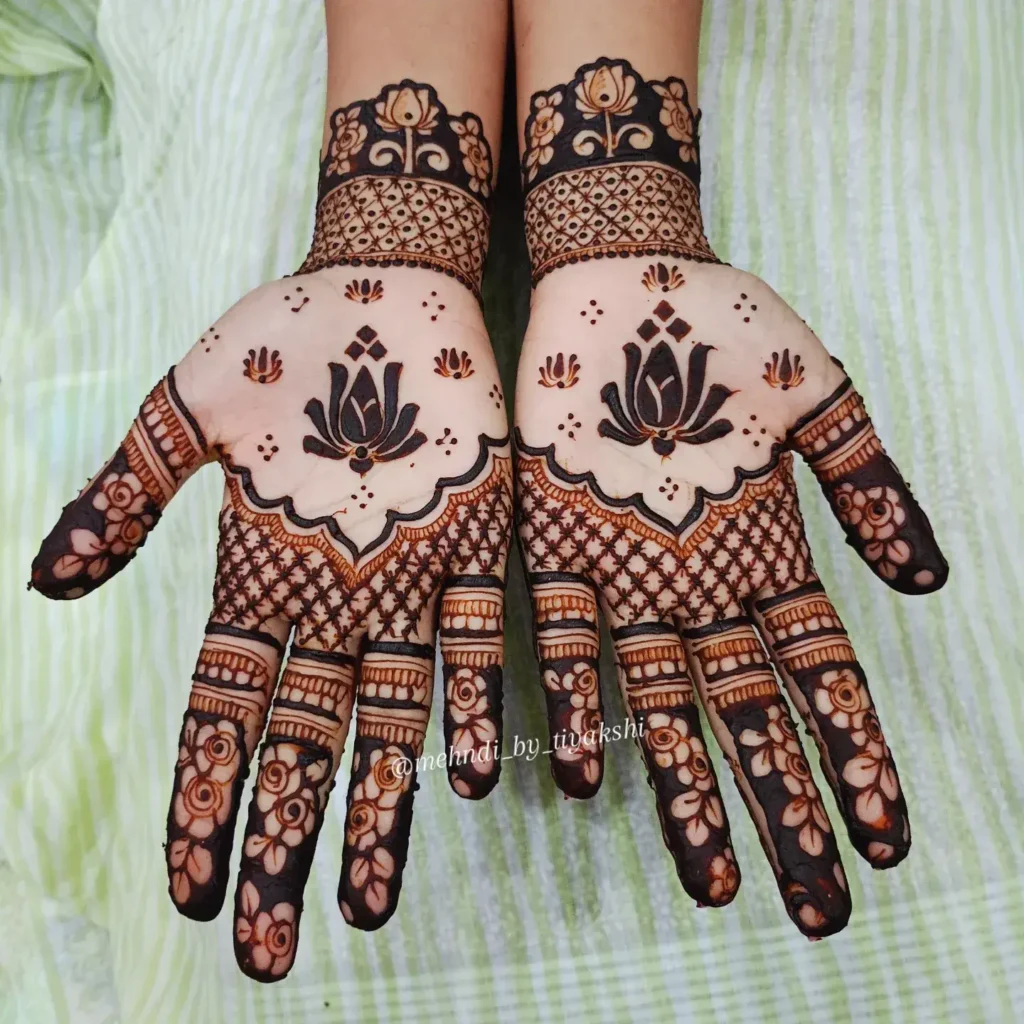
Mandala-Centered Royal Front Hand Mehndi Designs
A mandala works as a centerpiece on its own, without needing a peacock or lotus alongside it. Its circular shape naturally fits the palm, which is one reason it’s been a staple in South Asian art for centuries.
Classic Full-Palm Mandala Design
A large mandala fills most of the palm, built from concentric rings of dots, petals, and fine lines. Small motifs or jaali fill the gaps near the fingers. This is a full royal-density design, best suited to bridal events.
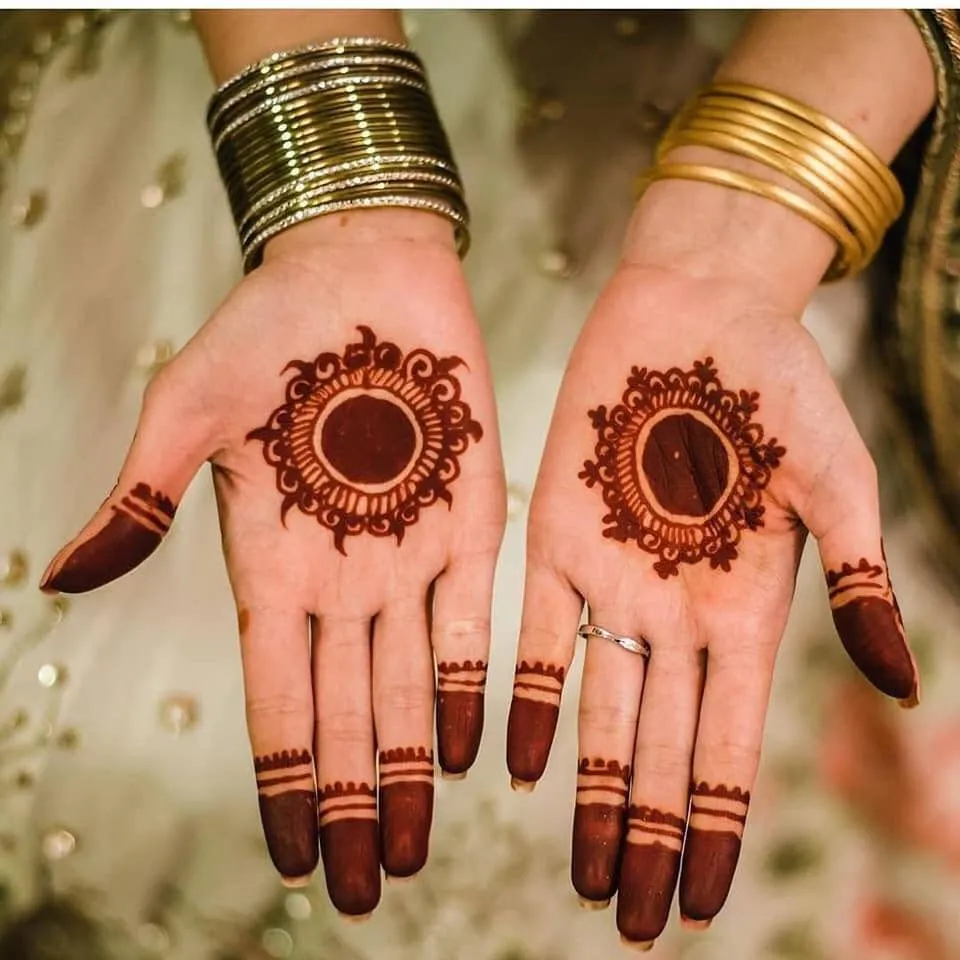
Geometric Mandala Design
Instead of rounded petals, this version uses straight lines, triangles, and diamond shapes arranged in a circle. It reads as more modern than a traditional floral mandala, while still keeping the same central-focus structure.
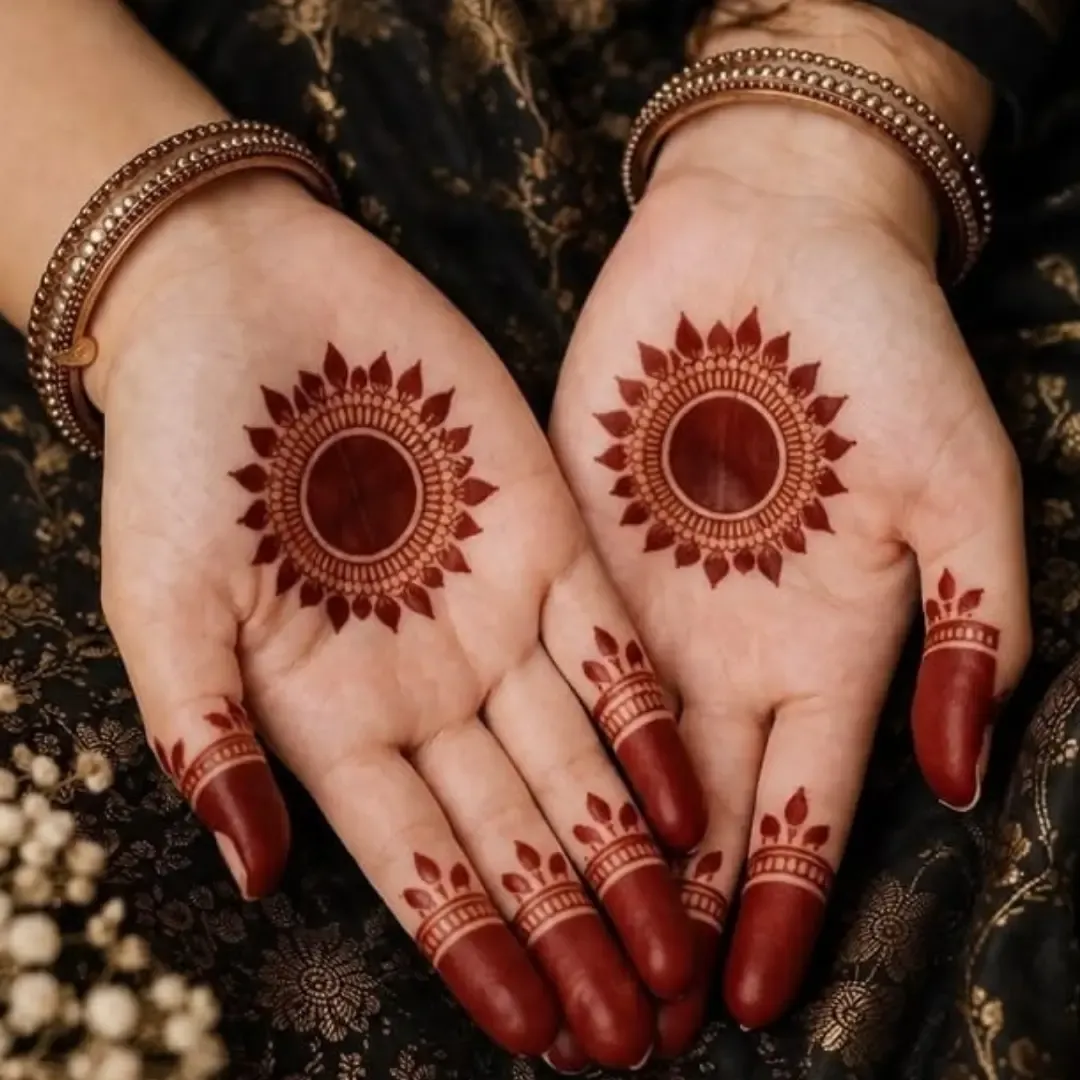
Mandala and Wristband Combo Design
A moderate-sized mandala sits at the center of the palm, paired with a matching band at the wrist. The two elements share a pattern, so the design feels connected rather than like two separate pieces stitched together.
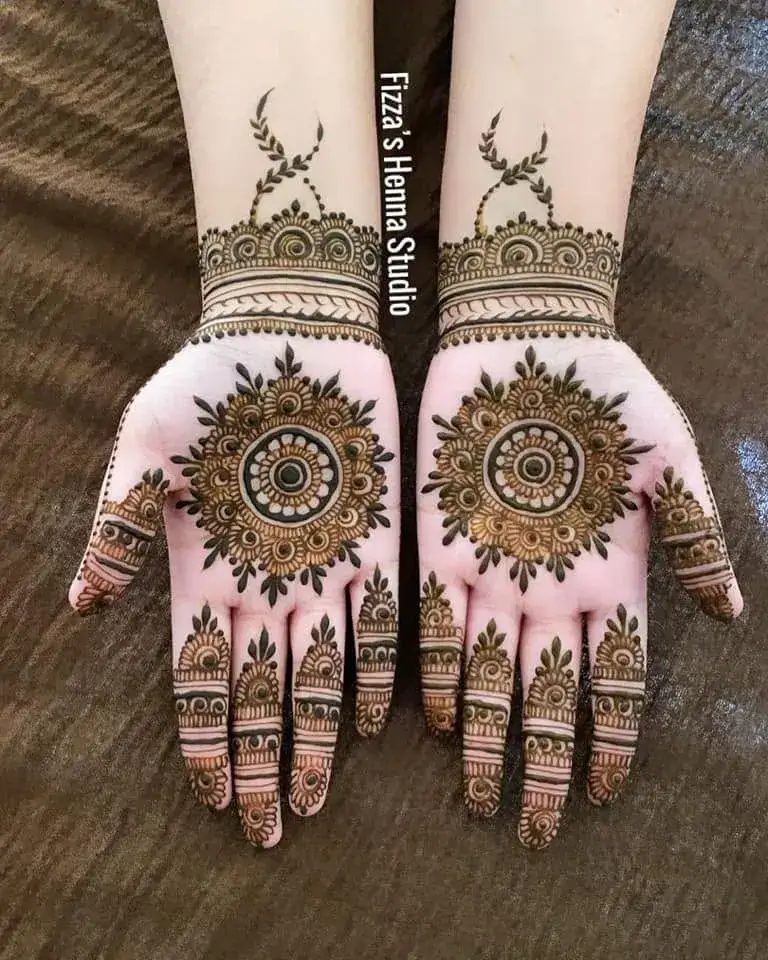
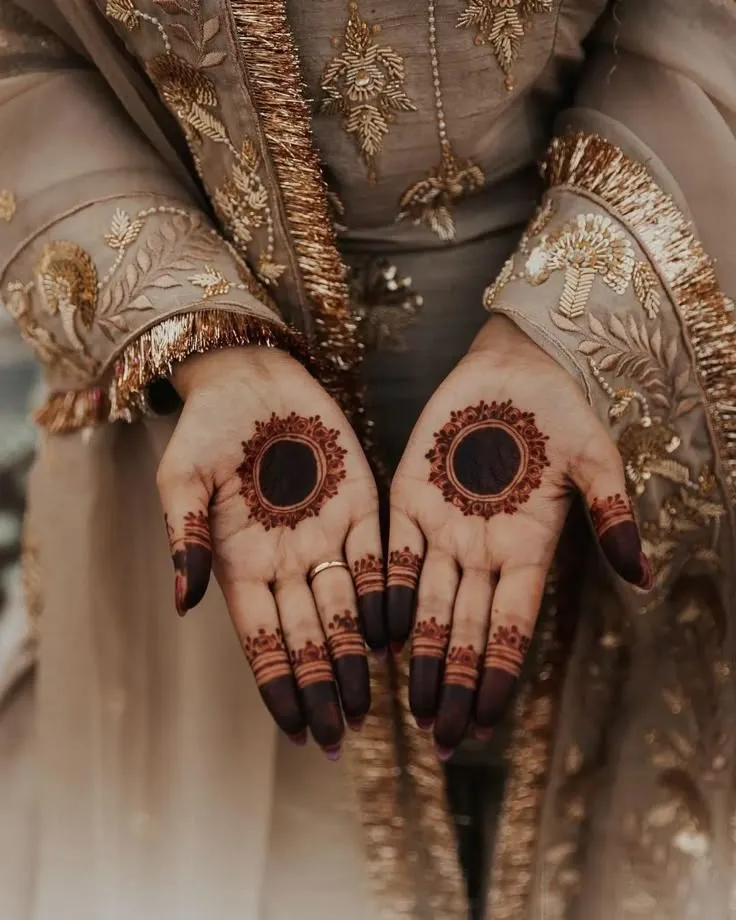
Minimalist Single Mandala Design
One small to medium mandala, no finger extensions, no wristband, just clean skin around it. This is the quickest mandala option and the easiest to keep symmetrical for anyone drawing it themselves.
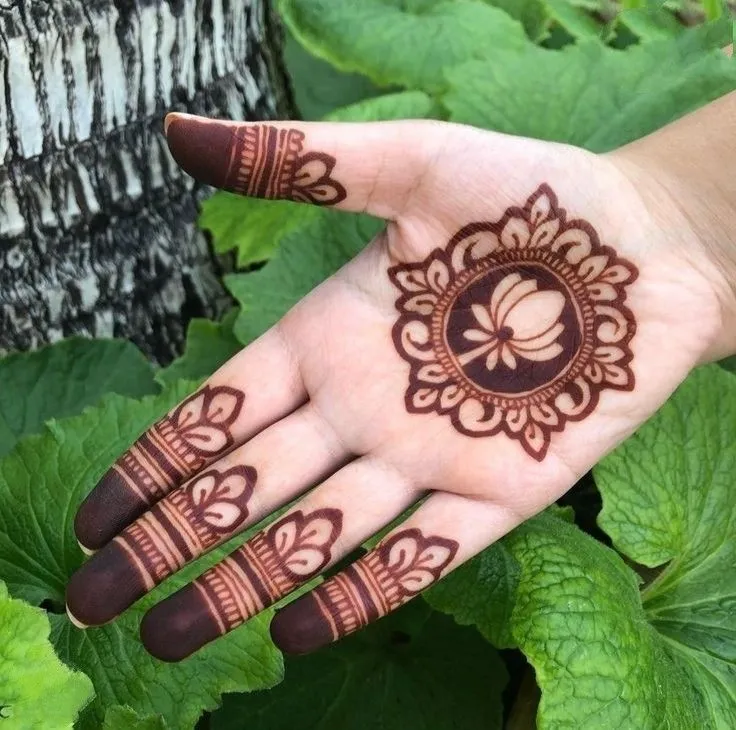
Mandala with Finger Extensions
The central mandala stays the same size, but thin lines and small dots extend outward to each finger. It ties the whole hand together without adding a second heavy motif, and it photographs well from a distance.
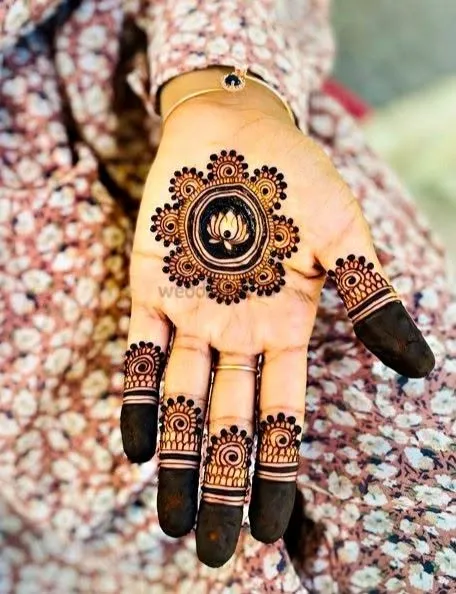
Jharokha (Arch) Royal Front Hand Mehndi Designs
The jharokha motif comes from the carved stone windows found in Rajput and Mughal palaces. In mehndi, it turns the palm into a framed scene instead of an open canvas, which is why it’s one of the more architectural-looking royal styles.
Classic Jharokha Window Design
A single arched window shape sits at the center of the palm, drawn with a scalloped or domed top. Inside the arch, the artist adds a small motif like a flower or dot pattern. The area outside the arch stays mostly bare, letting the shape read clearly.
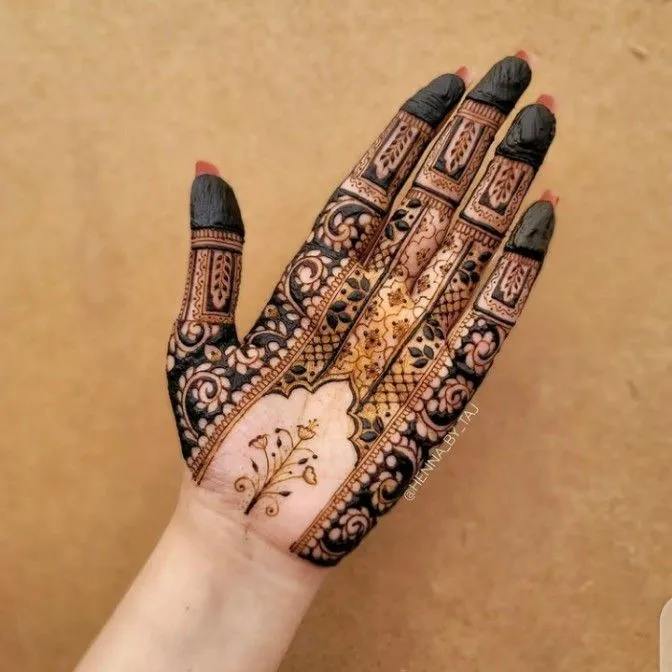
Double Jharokha Arch Design
Two arches sit side by side or stacked, each framing its own small motif. This adds more structure to the palm than a single arch, and it suits brides who want an architectural look without a full peacock or lotus centerpiece.
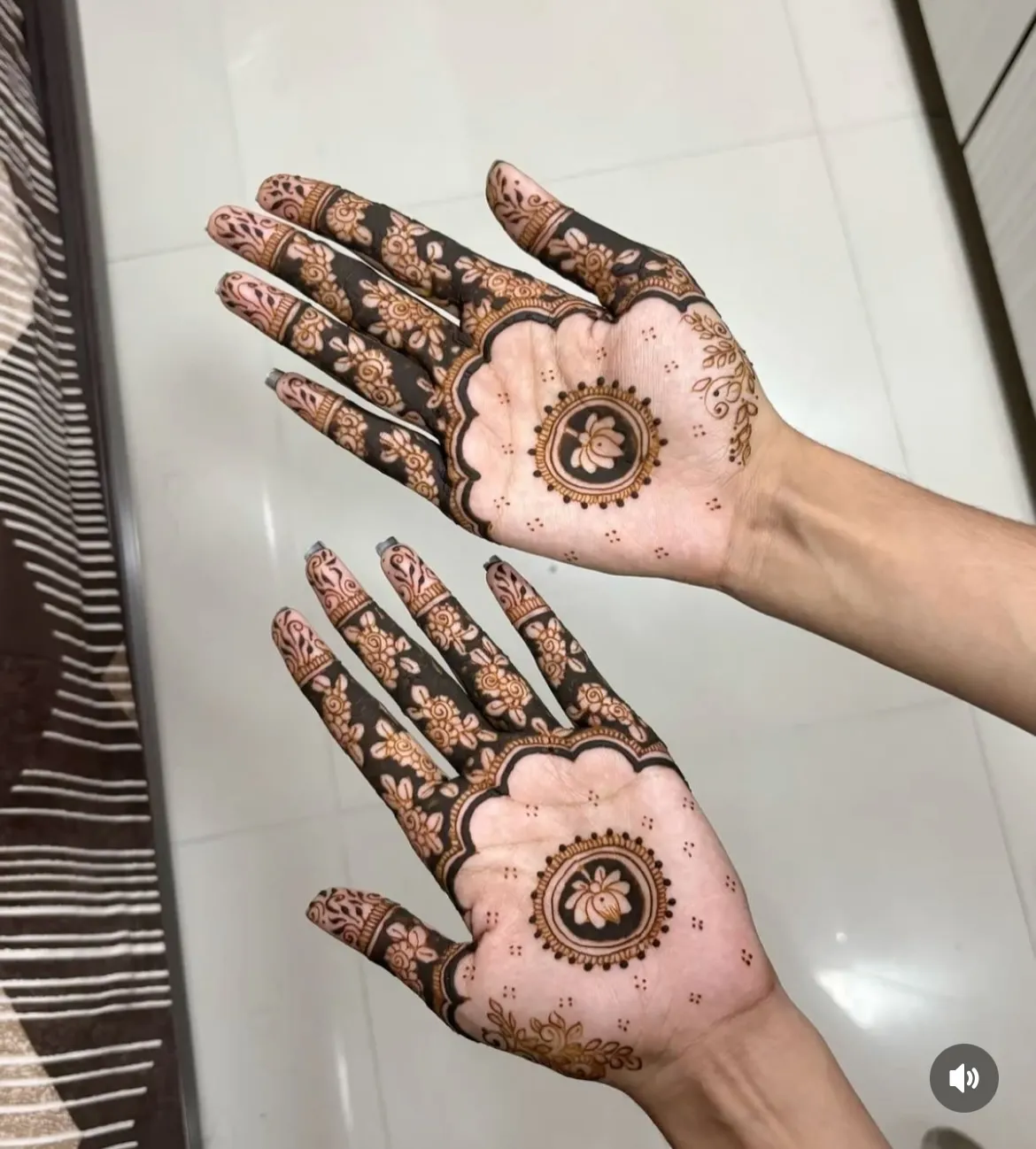
Jharokha with Peacock Inset
A peacock is drawn inside the jharokha arch instead of a plain floral fill. This combines two strong royal motifs into one focal point rather than spreading them across the hand, so it stays visually clean even at full bridal density.
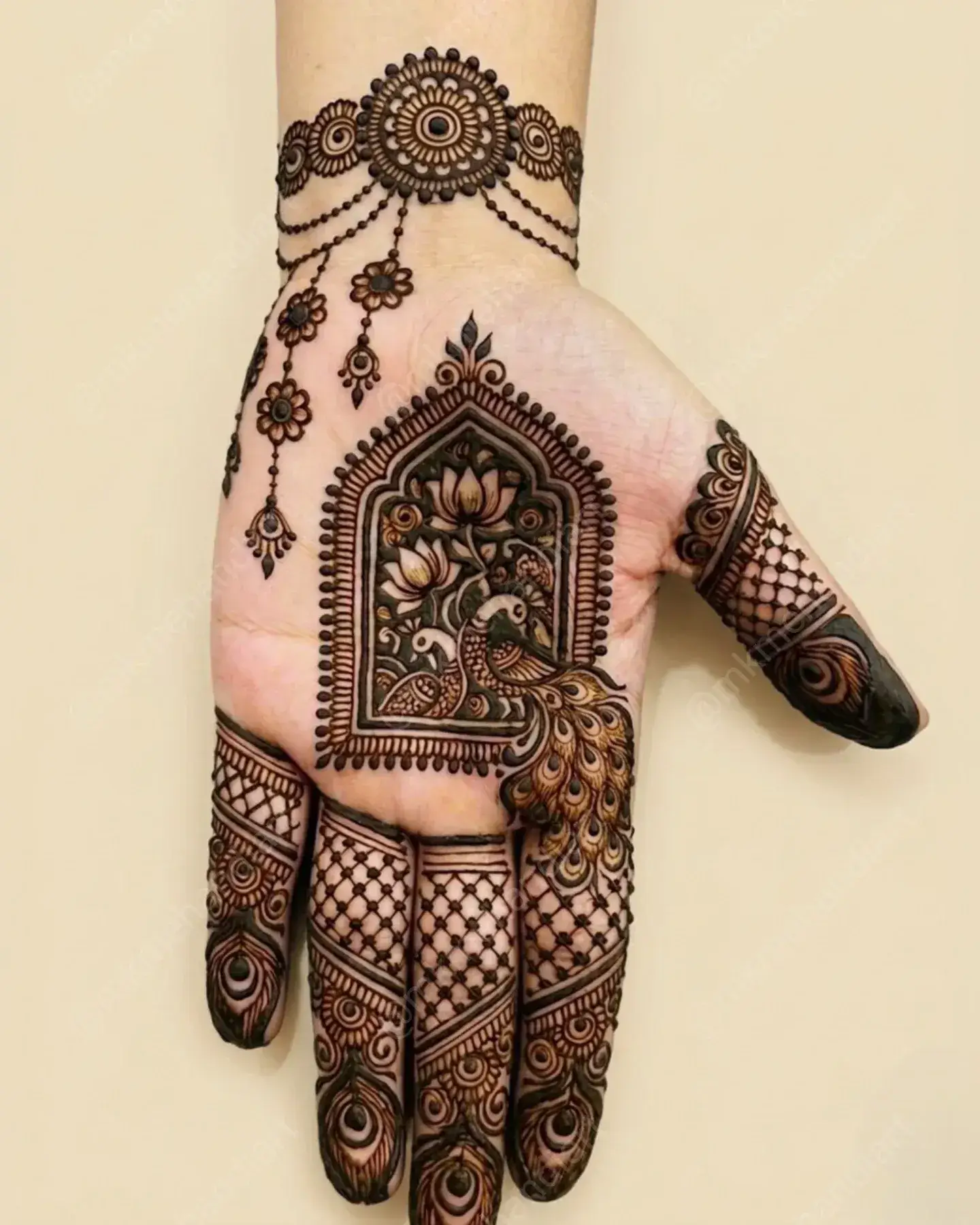
Jharokha with Floral Fill Design
The arch frames a cluster of small flowers instead of a single motif. Fine jaali or dot work fills the space between petals. This version leans softer and more floral than the peacock inset, while keeping the same architectural frame.
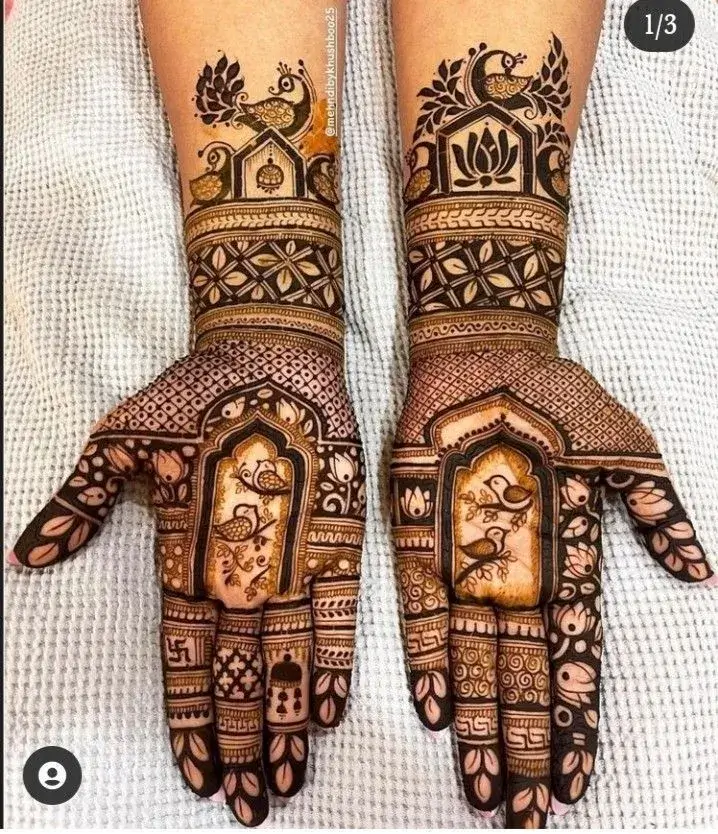
Jaali (Net) Royal Front Hand Mehndi Designs
Jaali is the net-like shading that gives royal mehndi its jewelry-like texture. On its own, without a peacock or lotus layered in, it lets the grid pattern itself carry the whole design.
Fine Jaali Palm Fill Design
A tight, even grid of fine lines covers most of the palm, with small dots marking each intersection. There’s no separate centerpiece here. The texture of the grid is the design, and it works best when the lines stay consistent in weight and spacing.
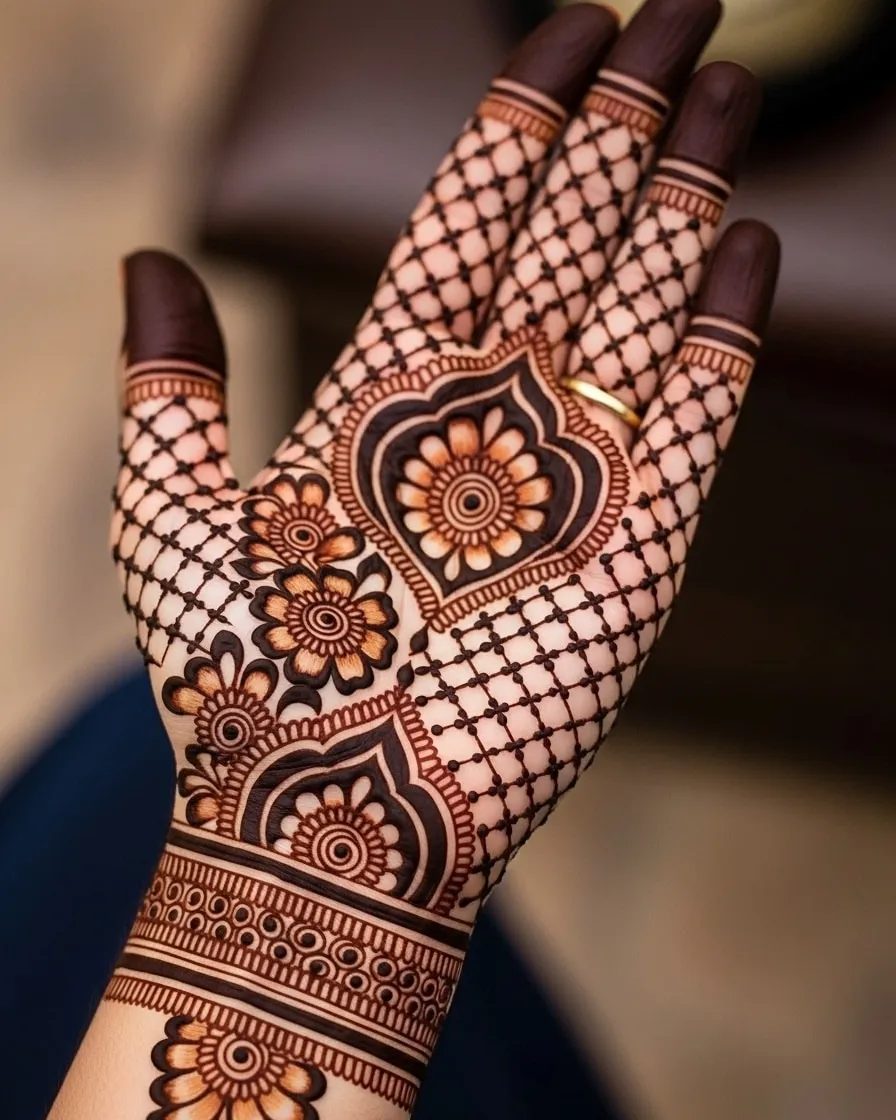
Jaali with Bharwa Fingertips Design
The palm carries a lighter jaali pattern, while the fingertips are filled in solid, a technique known as bharwa. The contrast between the open net and the solid tips gives the hand a finished, bridal look without needing a large central motif.
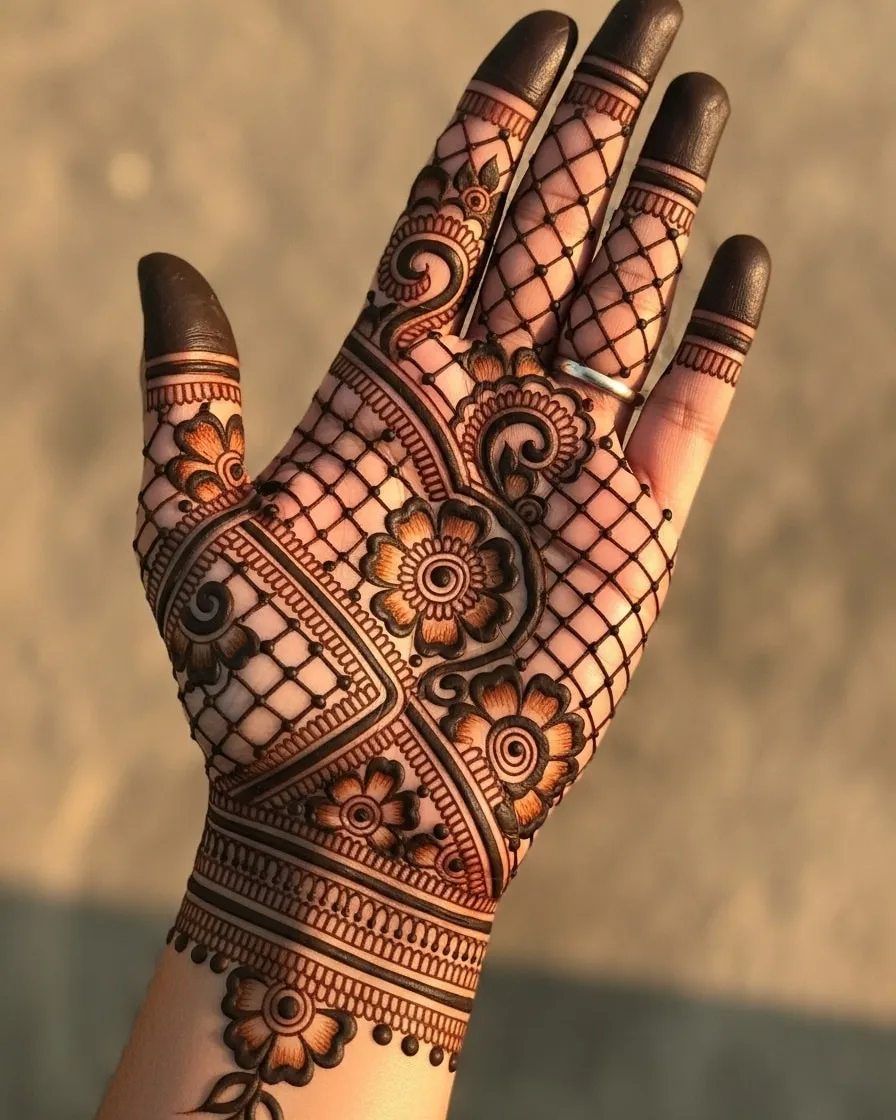
Diamond Grid Jaali Design
Instead of a fine crosshatch, this version uses larger diamond or square shapes across the palm, each one outlined and lightly filled. It reads as bolder and more modern than traditional fine jaali, closer to the geometric mandala style but applied across the whole hand.
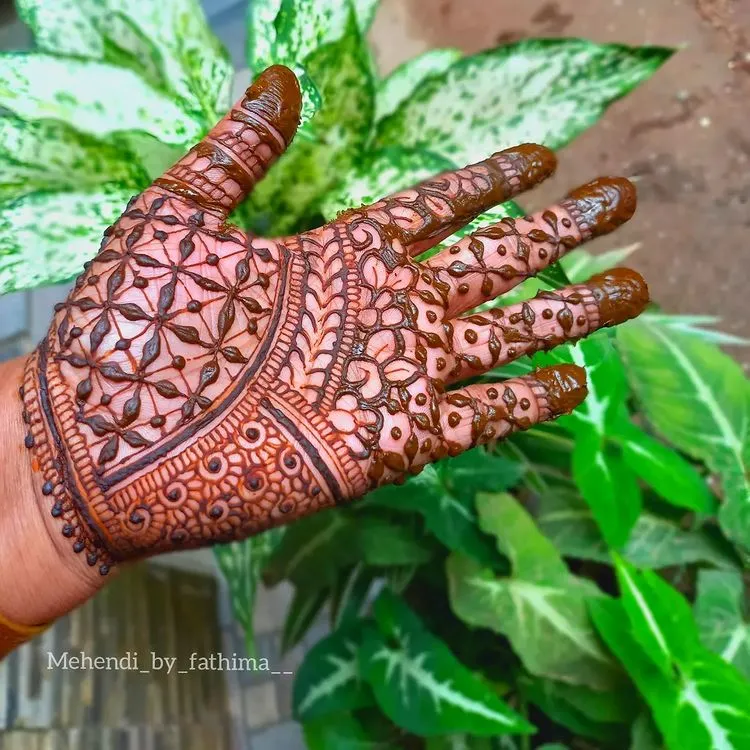
Jaali and Mandala Combo Design
A mandala sits at the center of the palm, surrounded by jaali extending out toward the fingers and wrist. This pairs the two most common royal building blocks, focal point and net shading, into one design rather than choosing between them.
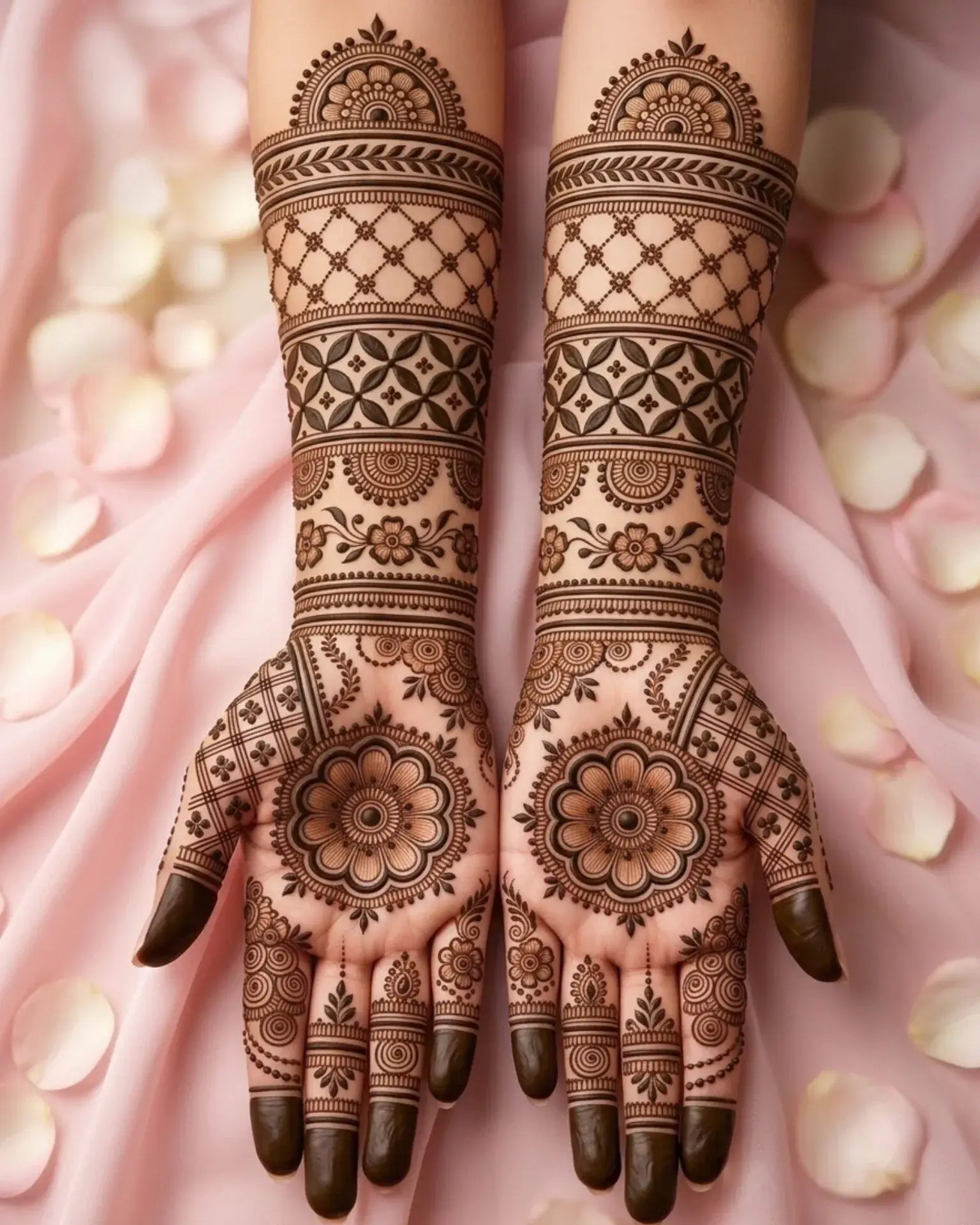
Jewellery-Style Cuff and Haathphool Simple Mehndi Designs
These designs skip a large central motif and instead mimic real jewelry. They work well when a bride wants a design that looks finished without much coverage, and they pair naturally with hands that will also wear rings or bangles.
Wrist Cuff Bracelet Design
A single band of pattern wraps around the wrist, like a bracelet drawn in henna. The rest of the palm stays bare. This is one of the fastest designs to apply and suits anyone who wants mehndi without covering the whole hand.
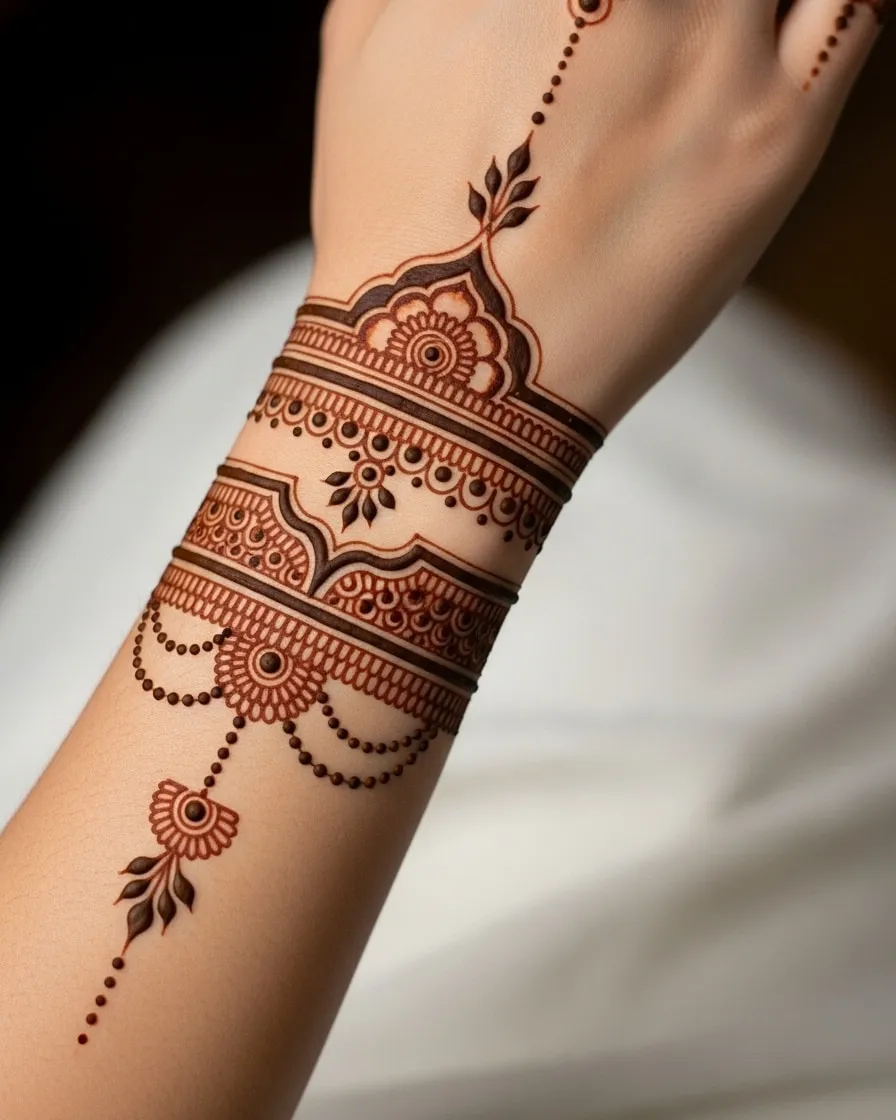
Haathphool Finger-to-Wrist Design
Haathphool is the traditional hand jewelry that connects a ring on the middle finger to a bracelet at the wrist with a thin chain. In mehndi form, this chain is drawn directly on the skin, so the bride gets the look of the jewelry without needing to wear it.
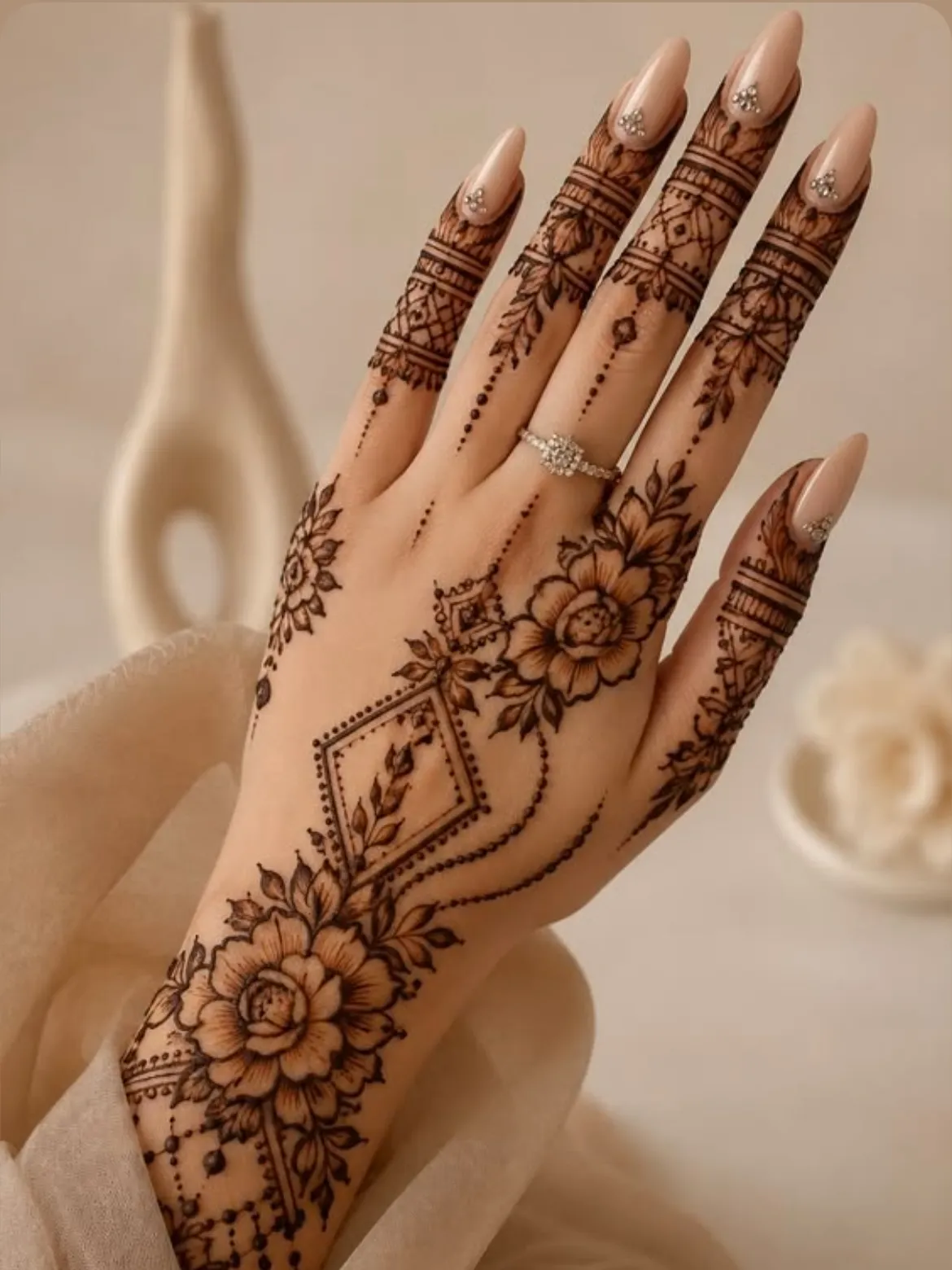
Layered Bangle-Style Cuff Design
Instead of one wristband, this design stacks two or three thinner bands close together, mimicking a set of layered bangles. It adds more detail than a single cuff while still staying limited to the wrist area.
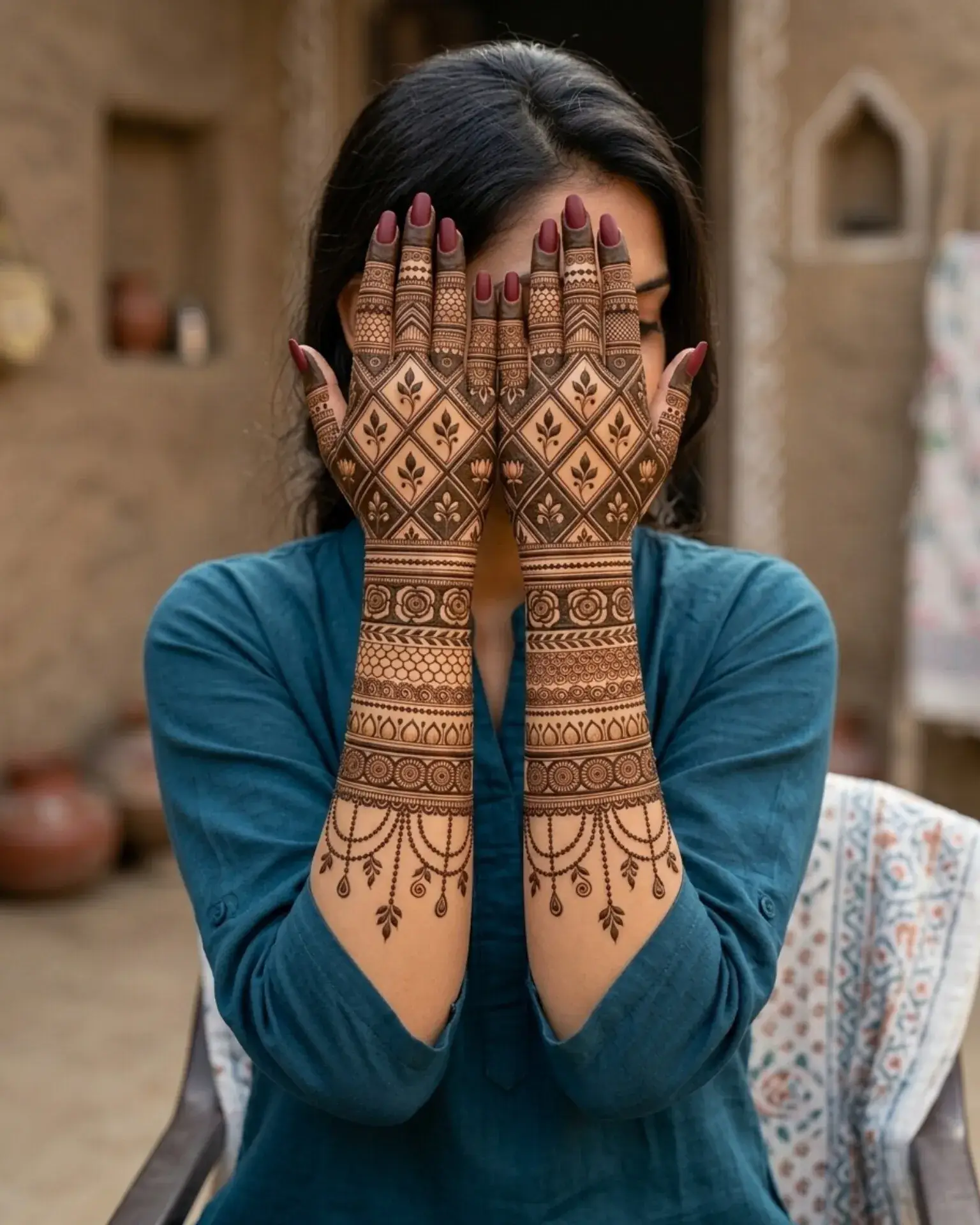
Ring and Chain Jewellery Design
Small ring motifs are drawn around each finger, connected by fine chain-like lines running down to the back of the hand. This design covers more of the hand than a simple cuff, but it still reads as jewelry rather than a traditional floral or peacock design.
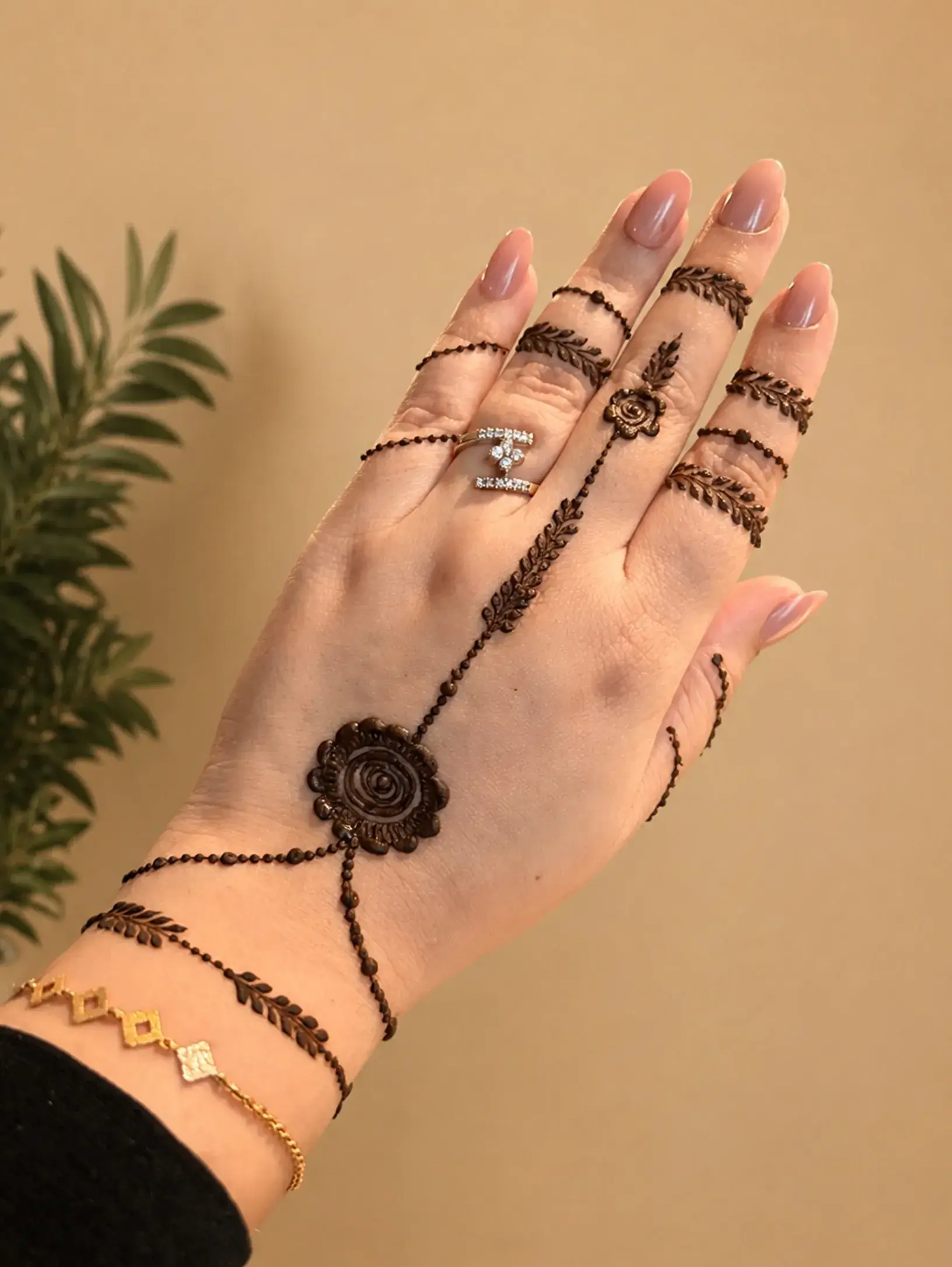
Arabic-Fusion Royal Front Hand Mehndi Designs
Arabic mehndi design uses bold outlines, large florals, and generous open space. Fused with Indian-style jaali and motifs, it keeps that bold, quick-to-read look while adding the fine detailing royal designs are known for.
Bold Diagonal Trail Design
A thick floral trail runs diagonally from the wrist to the fingertips, leaving the rest of the palm empty. The bold outer lines are pure Arabic style, while smaller Indian motifs like leaves or dots fill in along the trail.
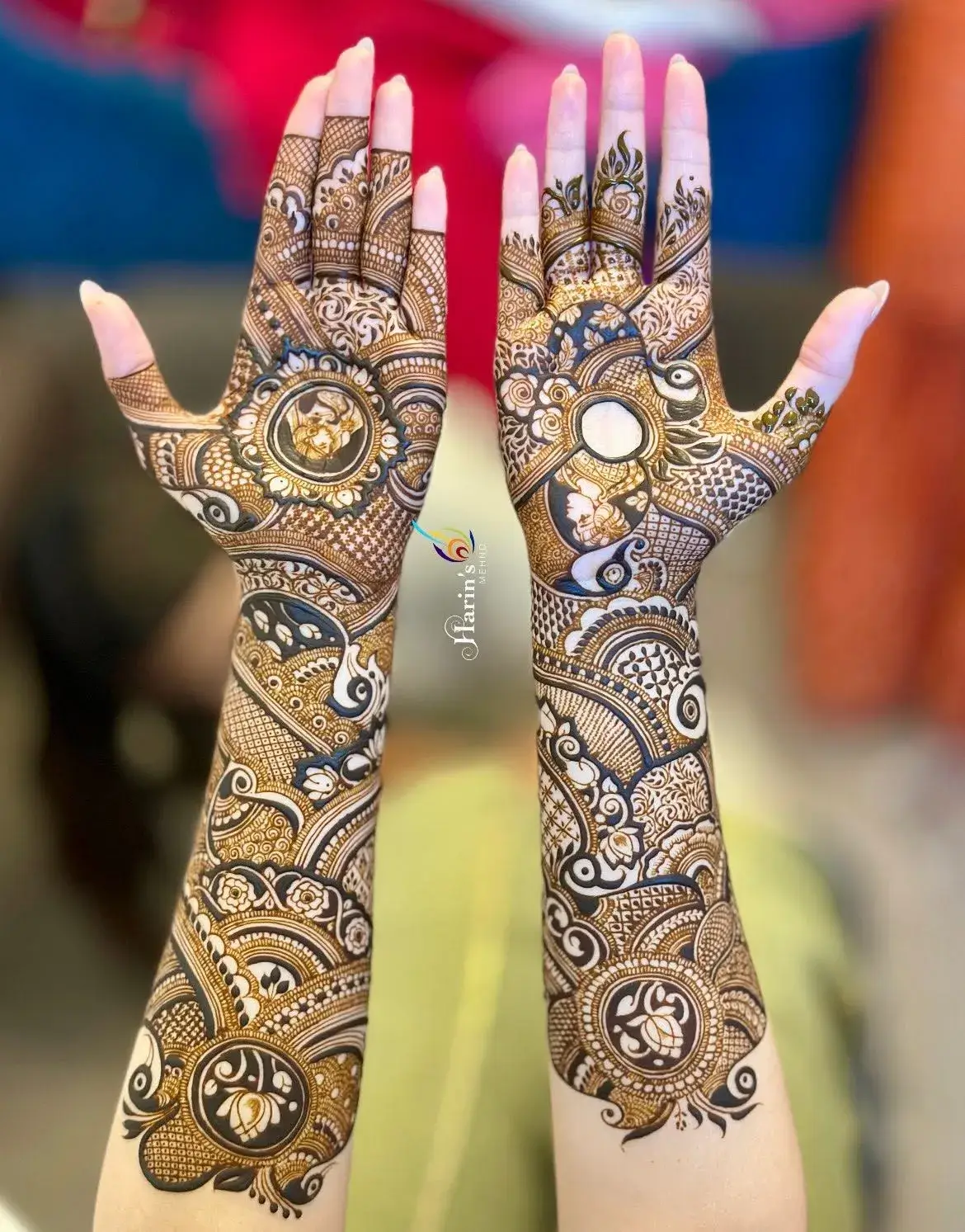
Arabic Rose and Jaali Fusion Design
A large rose sits on the palm or back of the hand, drawn with the bold, open strokes typical of Arabic mehndi. Its petals are shaded with fine jaali instead of a solid fill, blending the two traditions into one motif.
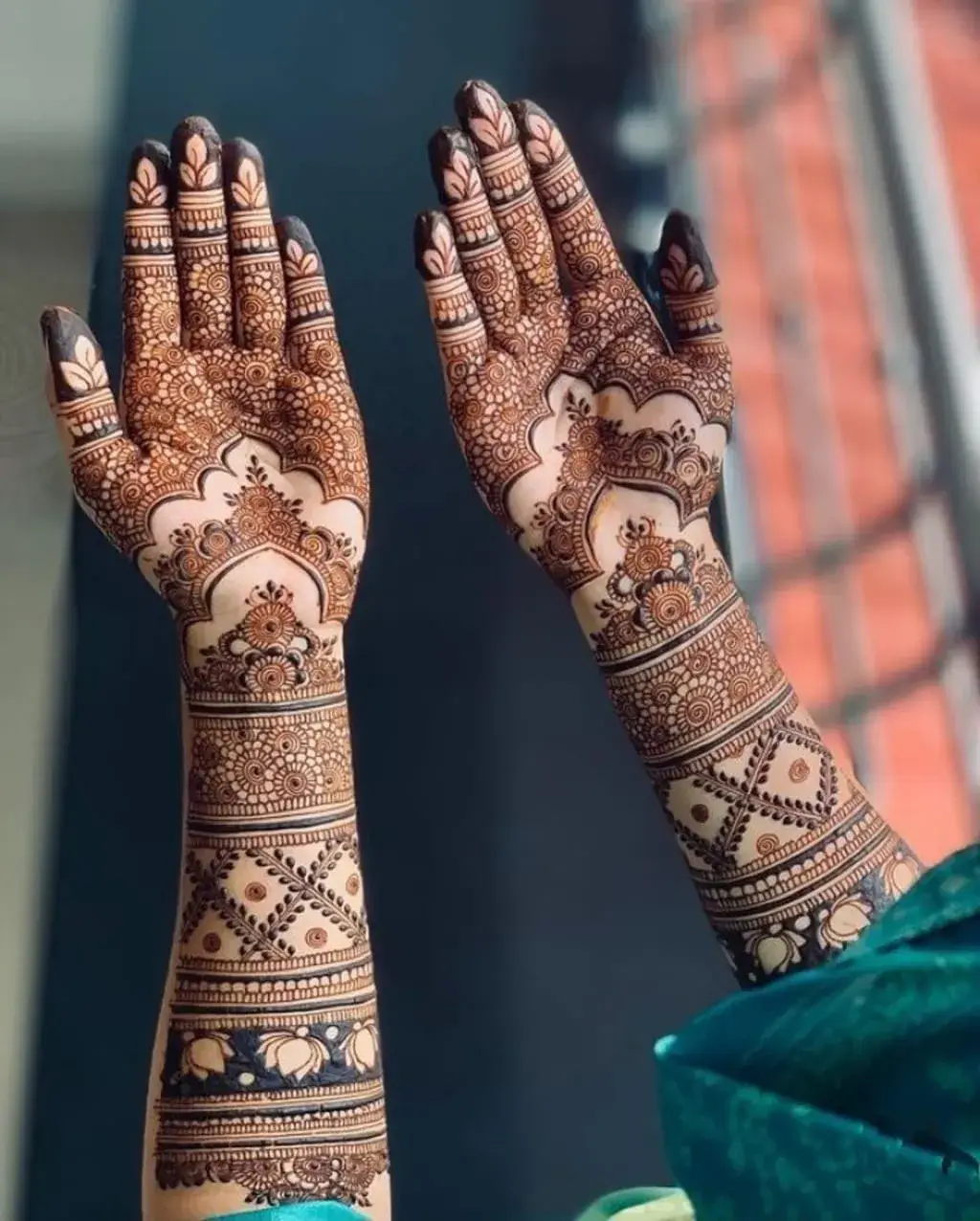
Indo-Arabic Bracelet Trail Design
A wrist cuff connects to a flowing Arabic-style vine that moves up toward one or two fingers. This combines the jewelry-inspired cuff design with the sweeping, open layout Arabic mehndi is known for.
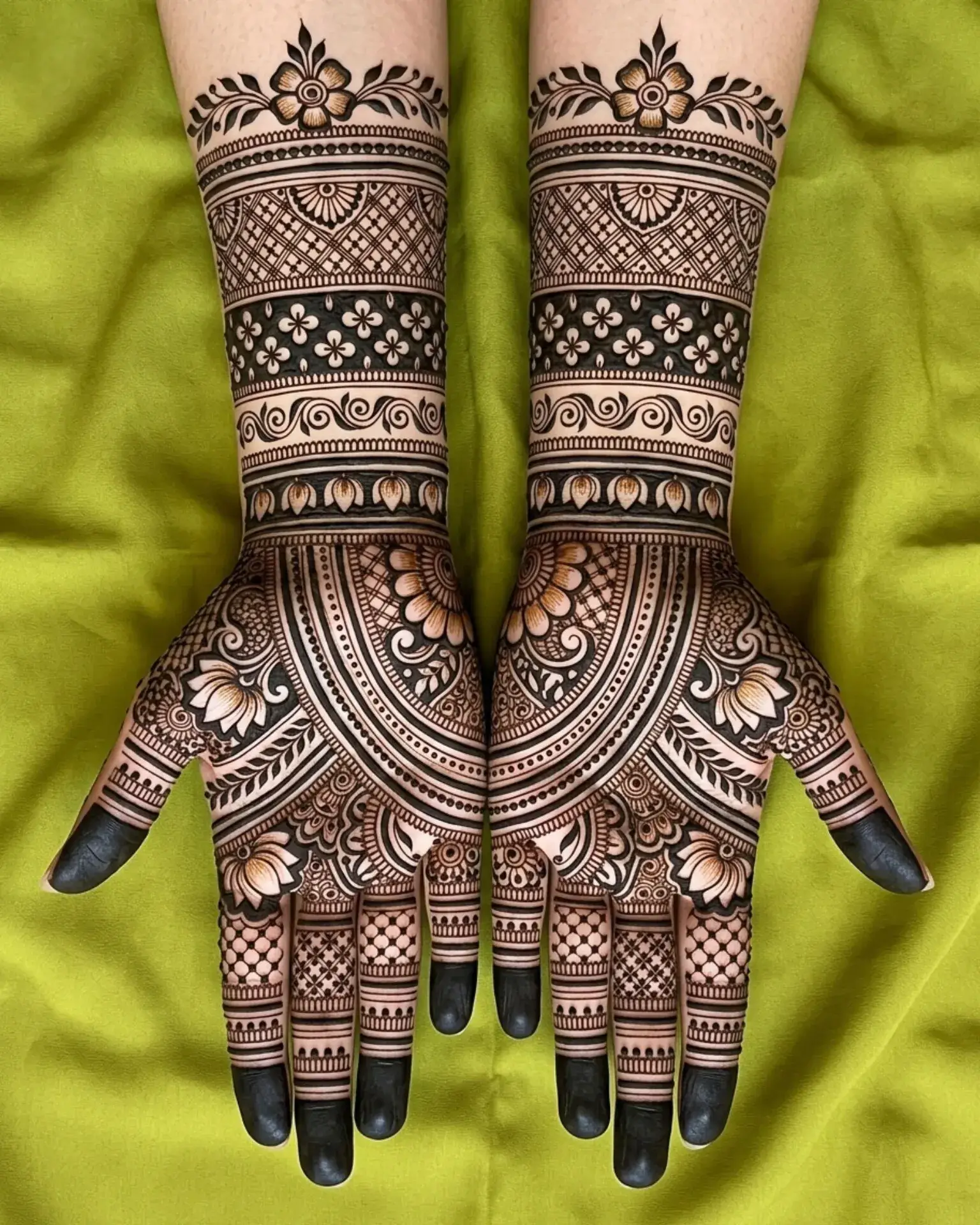
Open Petal Statement Design
One or two large, open flowers anchor the design, drawn with thick outlines and left mostly unshaded inside. This is one of the quickest fusion designs to apply, since the impact comes from scale and boldness rather than fine detail.
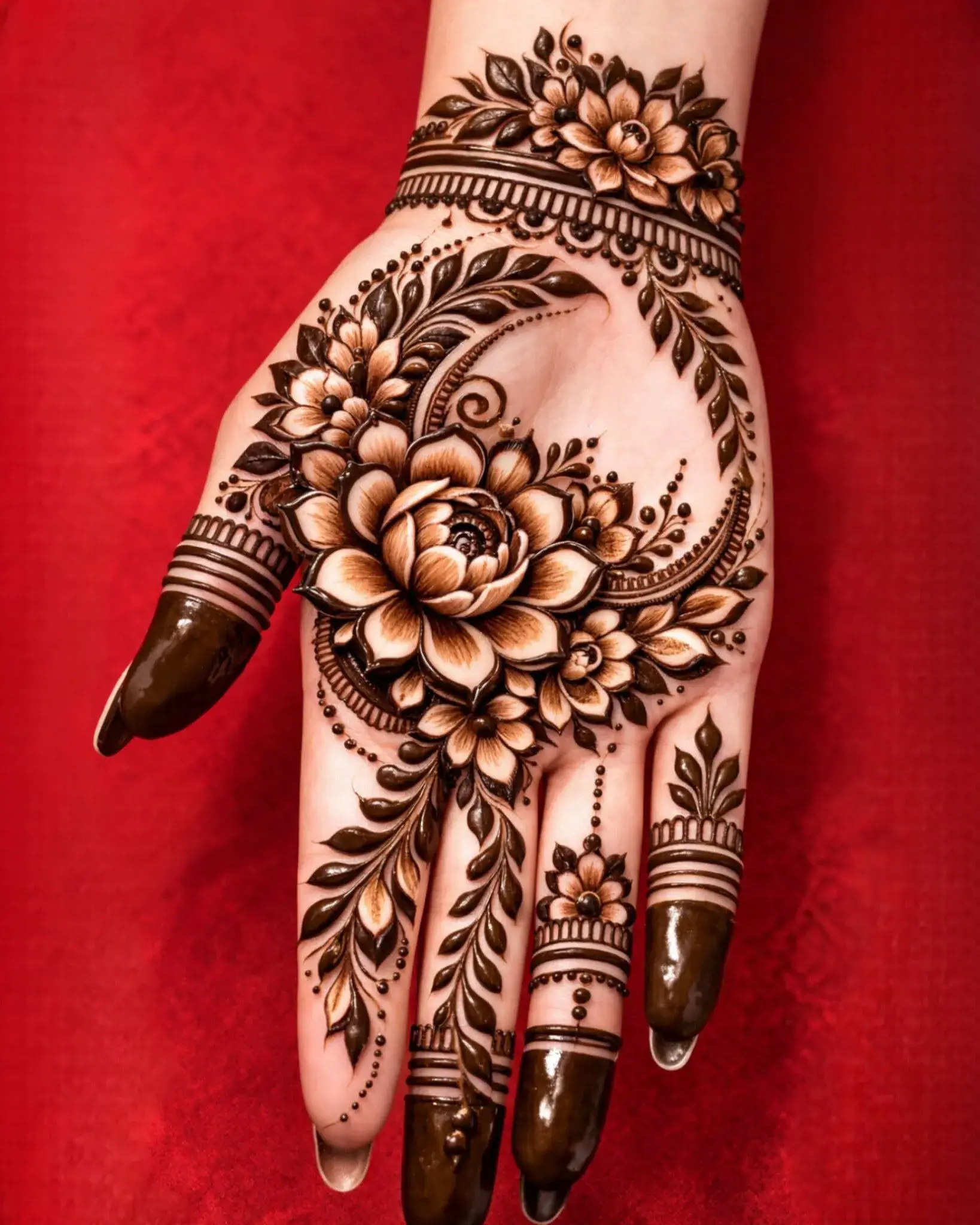
Fusion Finger Detail Design
The palm stays mostly bare, while the fingers carry Arabic-style floral bands mixed with small Indian jaali sections. This keeps the design light on the hand while still showing both traditions clearly.
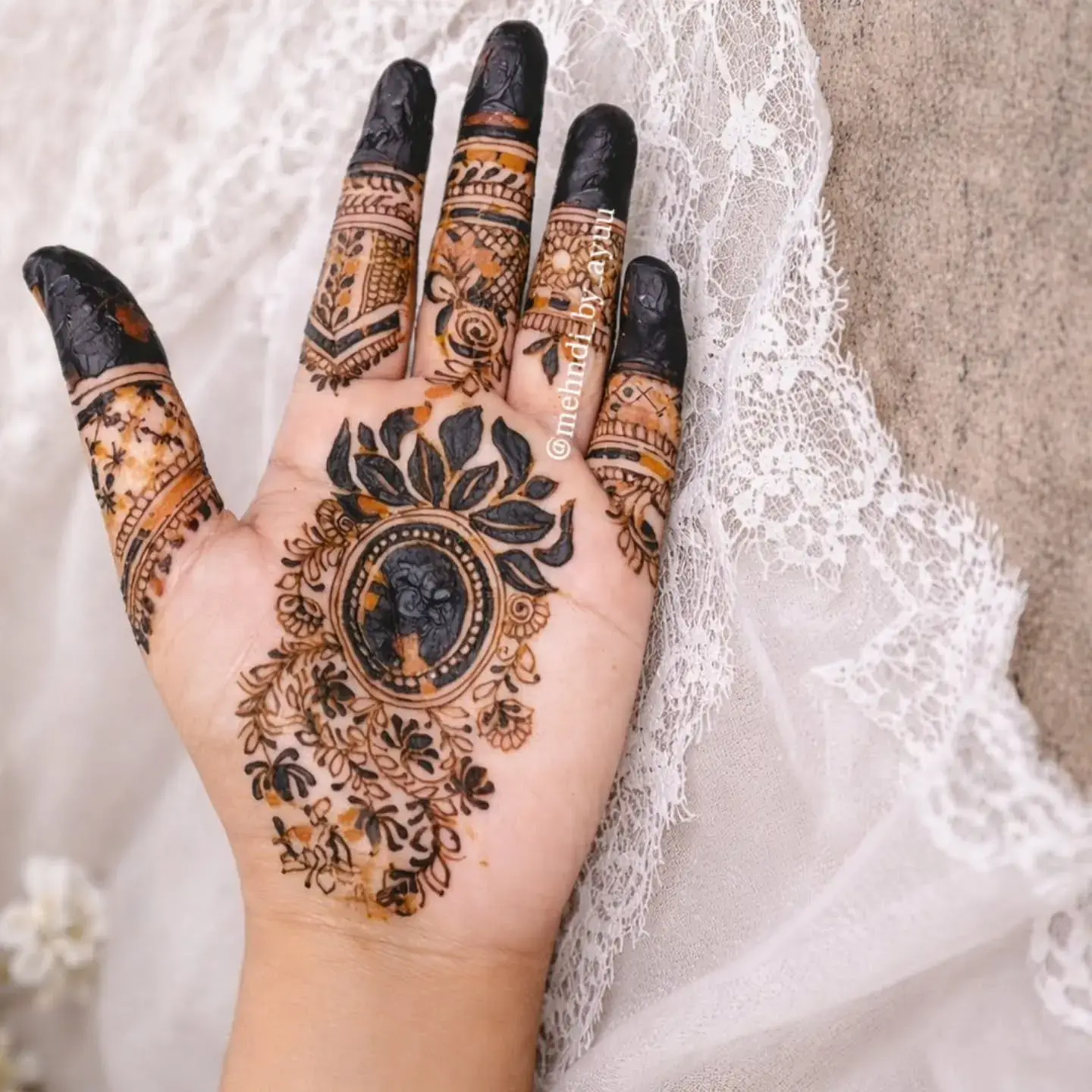
Simple Royal Front Hand Mehndi Designs for Beginners
These designs keep the royal look, a clear focal point, real motifs, and open space, but scale everything down. They’re a good starting point for anyone applying mehndi themselves for the first time.
Single Motif Center Design
One motif, such as a small flower or a single peacock feather, sits in the middle of the palm with nothing else added. Because there’s only one shape to draw, it’s easier to keep the lines clean and even.
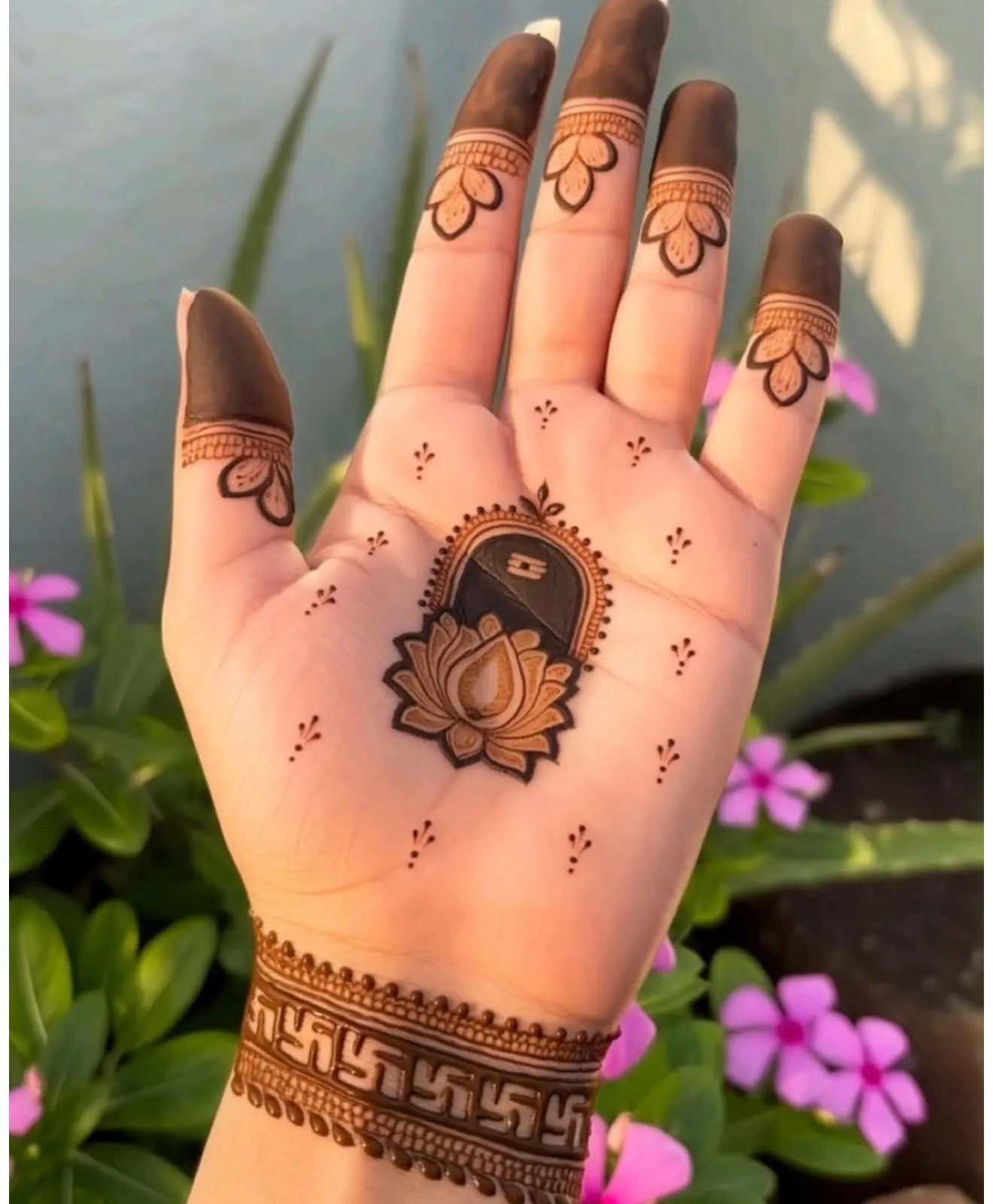
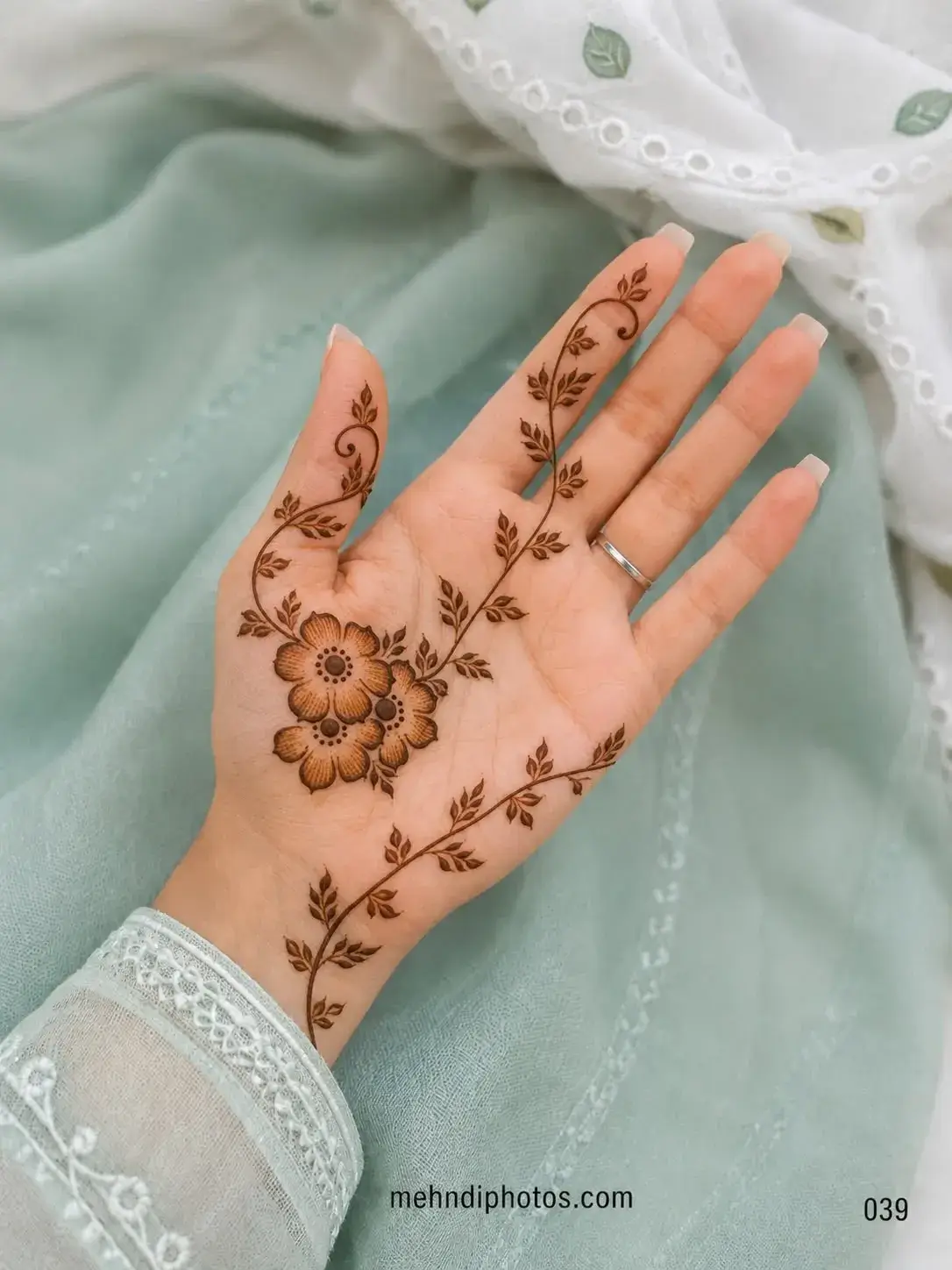
Minimal Floral Vine Design
A thin vine with a few small leaves runs from the wrist toward one finger. It leaves most of the hand bare and doesn’t need shading or fill work, which makes it forgiving for a first attempt.
Finger-Focused Royal Design
Instead of decorating the palm, this design puts all the detail on one or two fingers, small bands, dots, or a tiny motif at each fingertip. It’s a low-risk way to practice fine linework without committing to a full palm design.
Ring-Style Beginner Design
A simple ring shape is drawn around the base of one or two fingers, sometimes connected to a small dot or line on the back of the hand. It takes only a few minutes and still reads as an intentional design rather than an unfinished one.
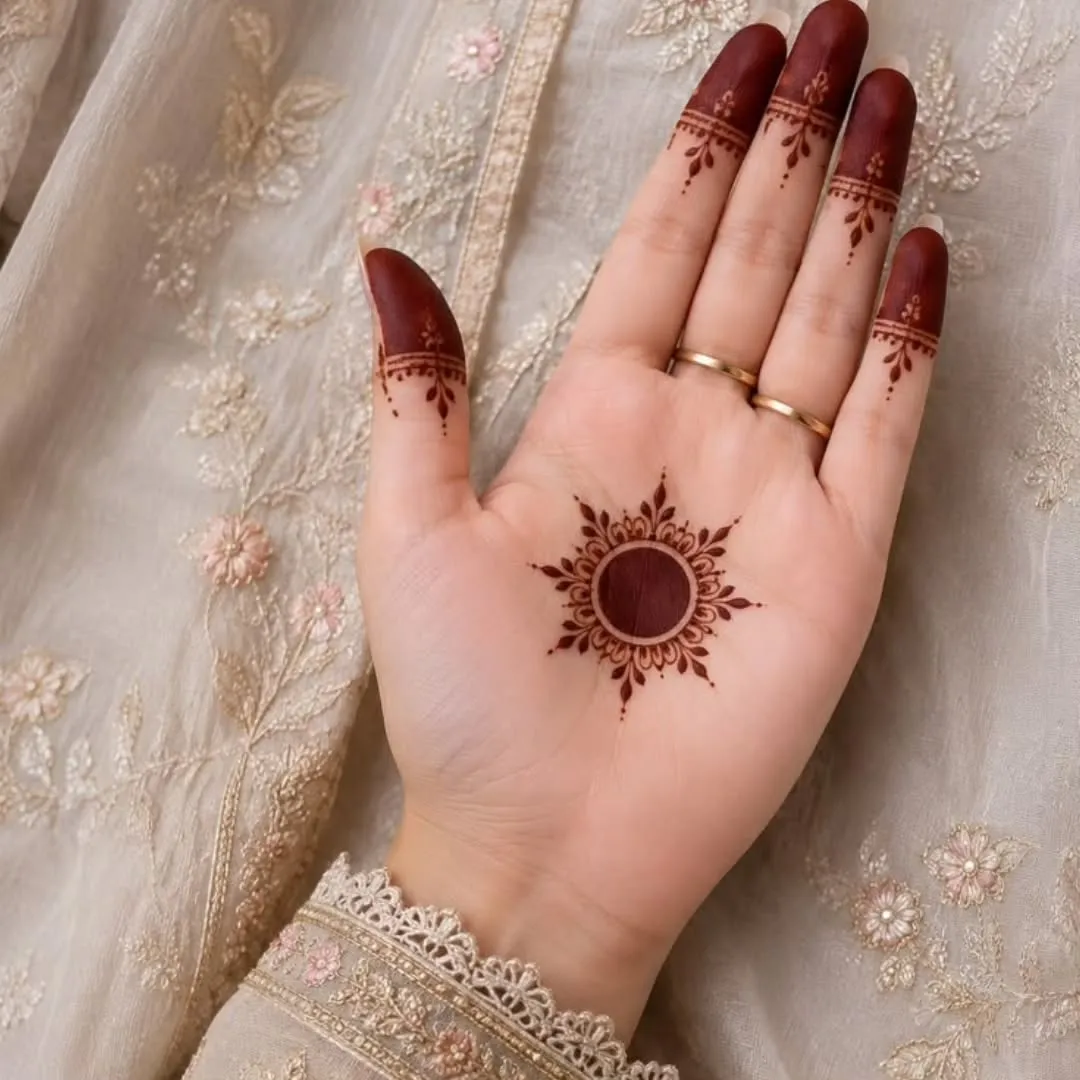
Small Mandala with Negative Space
A small mandala, no larger than a coin, sits at the center of the palm. The circular shape makes it easier to keep symmetrical than a floral design, and the bare skin around it hides small mistakes.
Choosing a Royal Design for Your Hand Shape
The same design won’t suit every hand the same way. A few adjustments make a big difference in how balanced the final result looks.
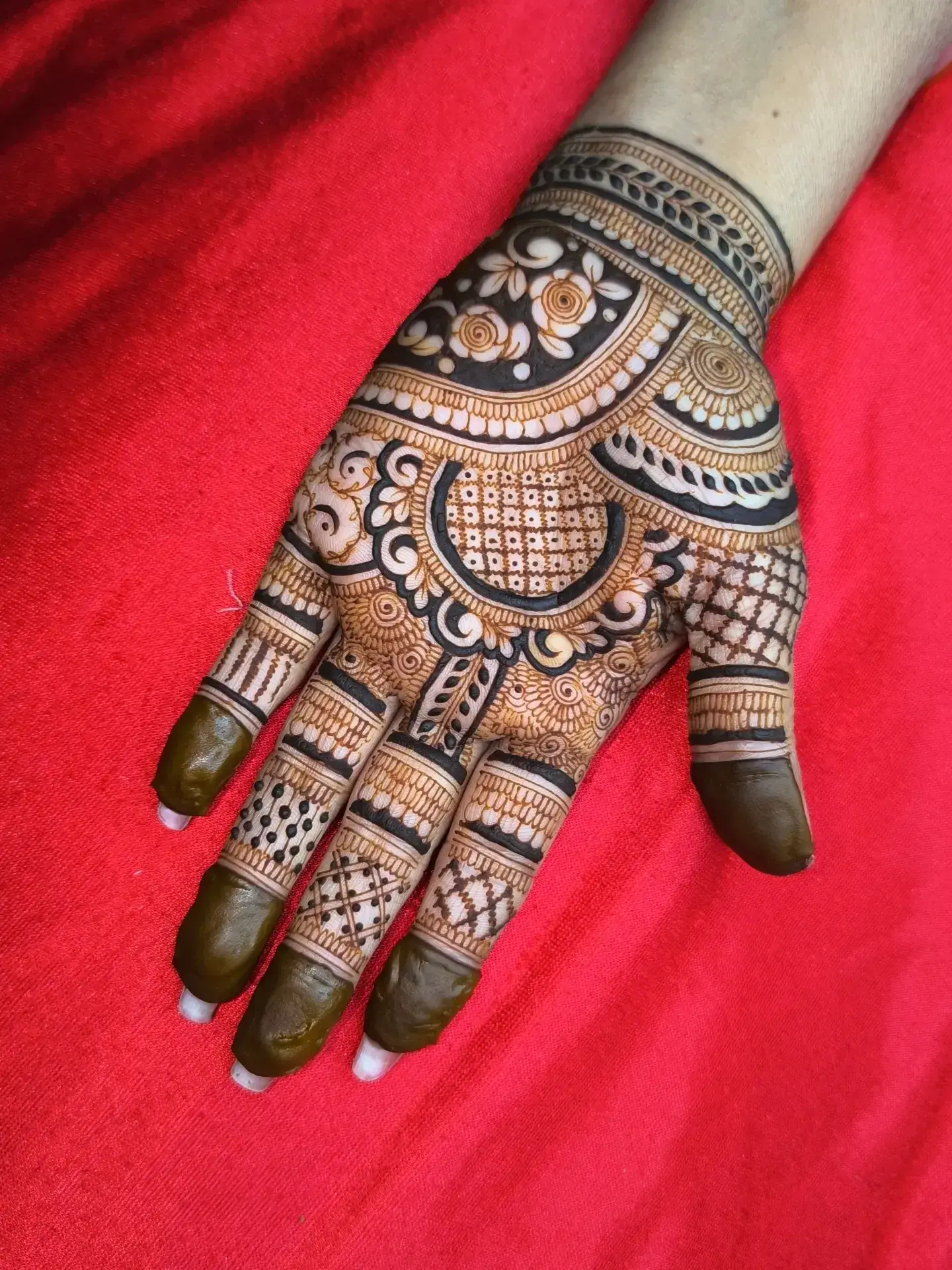
For Slender, Long Hands
Long hands can carry denser jaali work and horizontal bands without looking crowded. Ring-style bands across two or three finger joints help balance out the length, and a wider cuff at the wrist grounds the design instead of letting it feel like it’s floating.
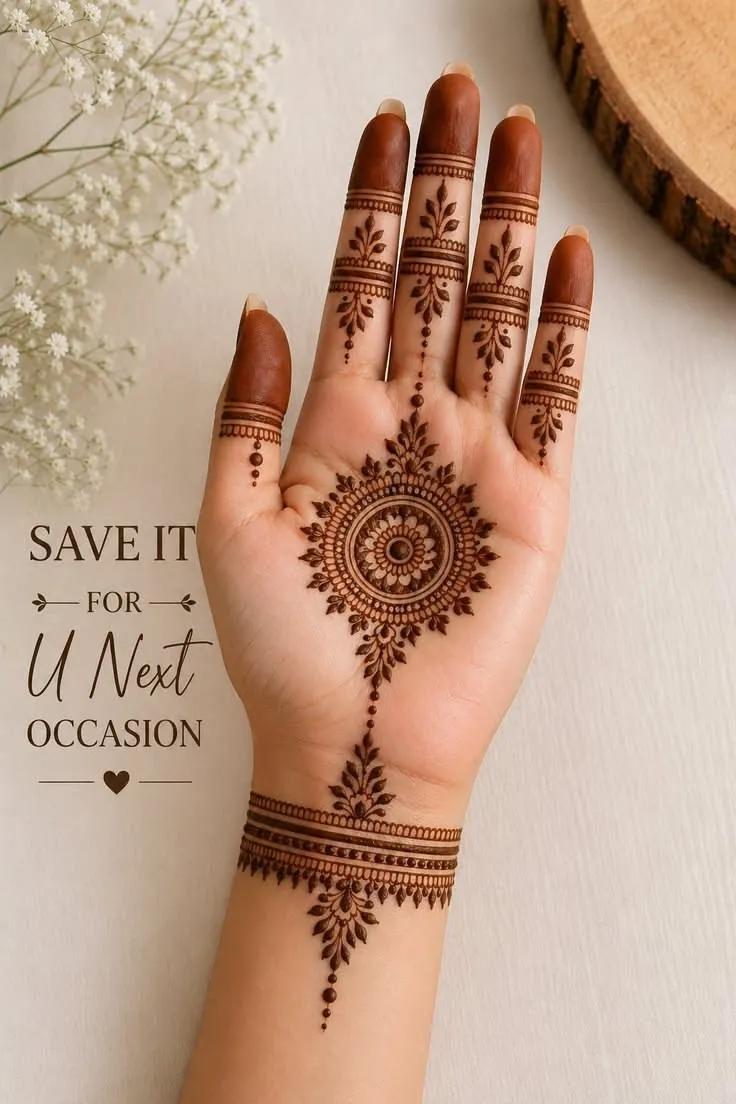
For Petite Hands
Heavy, dense bridal designs tend to blur together on smaller hands as the mehndi darkens. A smaller central motif with generous negative space around it stays clearer and easier to read, even after the color has fully set.
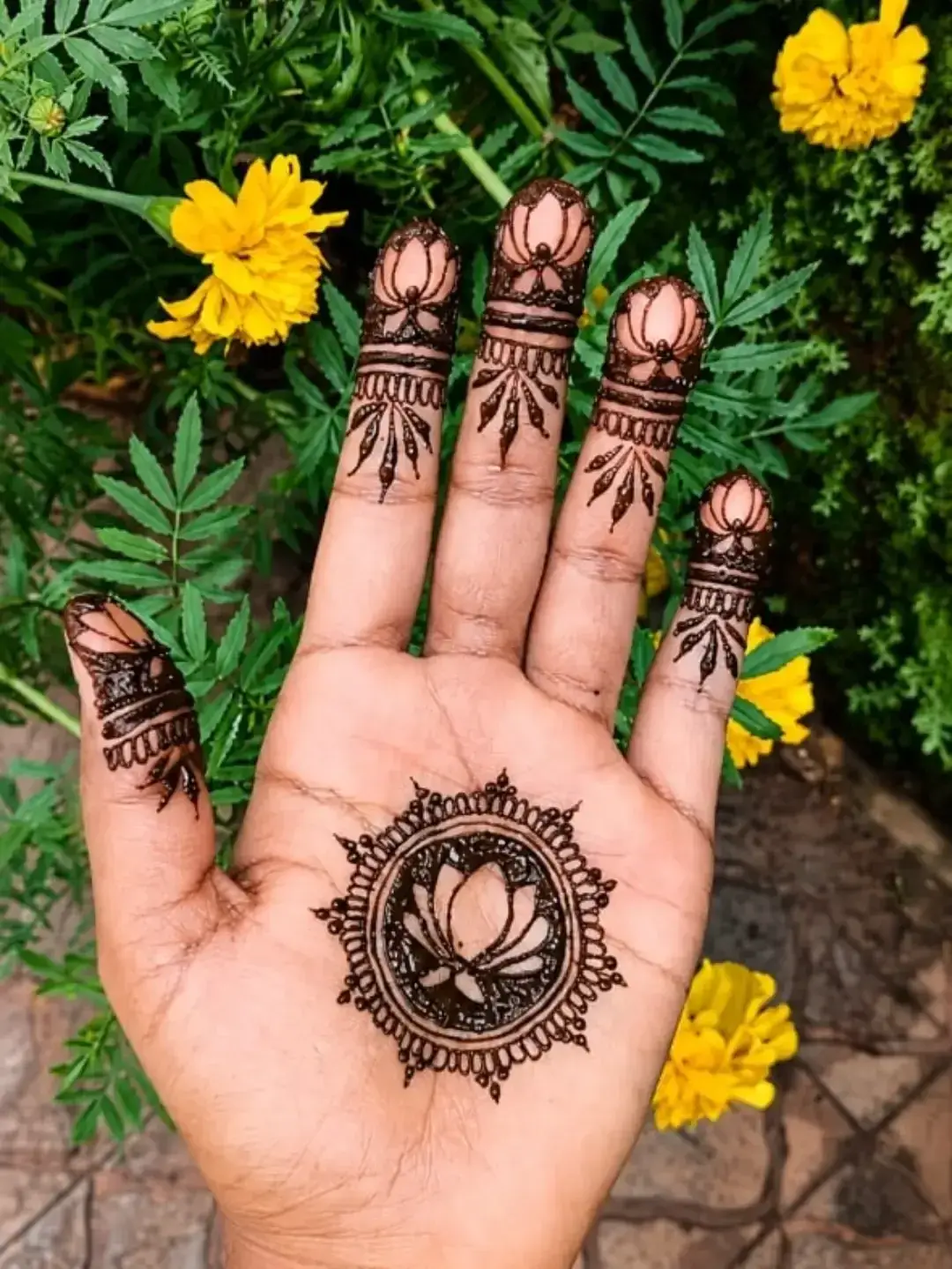
For Broad Palms and Shorter Fingers
Avoid thick horizontal bands across the palm, since they can make the hand look wider. A central mandala or a jharokha arch works better here, with thin vine trails running up toward the fingers to create a sense of length. Keep finger detailing light and open rather than filling each finger solid, which can make them look shorter.
Royal Mehndi for Every Occasion
The right density and motif depend on the event. A design built for a full wedding day rarely suits a quick Eid touch-up, and the reverse is true too.
| Occasion | Best Density | Common Motifs | Typical Time |
| Wedding and Bridal Ceremonies | Full coverage | Peacock, lotus, jharokha, personal details | Several hours |
| Engagement and Sangeet | Moderate | Mandala, jaali, cuffs | About an hour |
| Eid | Light to moderate | Arabic florals, crescent motifs | Under an hour |
| Karva Chauth and Teej | Moderate | Lotus, mandala, peacock and lotus pairings | Around an hour |
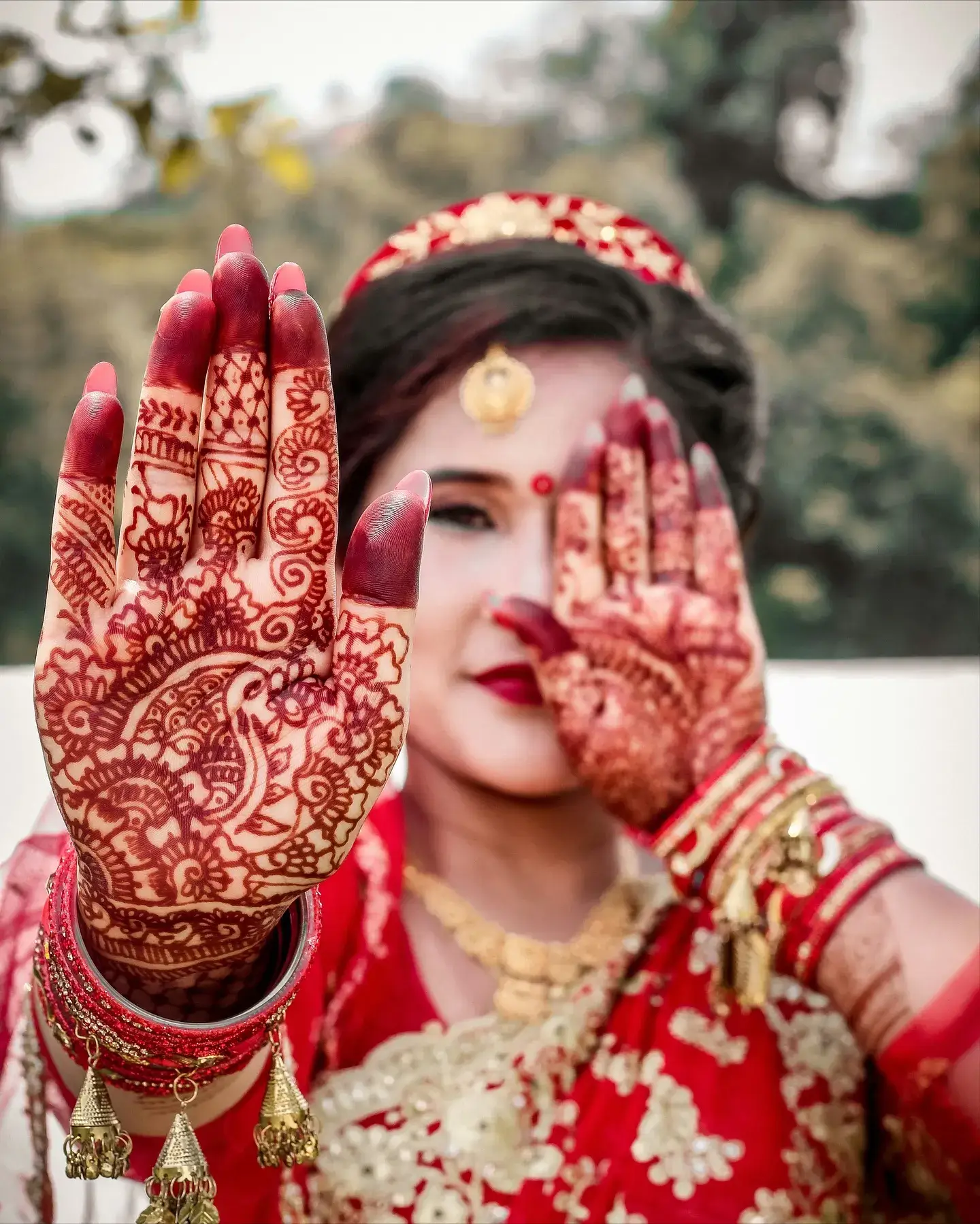
Wedding and Bridal Ceremonies
This is where full royal density makes sense. Hands stay in focus for hours of rituals and photography, so heavier designs with peacocks, lotus medallions, and jharokha arches hold up well. Many brides also have personal details, like a wedding date or a partner’s name, worked into the pattern. For brides, a dense royal front hand pattern is traditionally balanced with matching back hand mehndi designs featuring cuffs, haathphool, or fine jaali work to ensure both sides look cohesive in photographs. Many brides plan their feet as well, with matching bridal foot and leg mehndi designs.
Karva Chauth and Teej
These festivals often pair lotus and peacock motifs, sometimes with the husband’s name or initials hidden in the design.
Moderate density works well here, detailed enough to feel festive, but quick enough to fit into an evening of preparation.
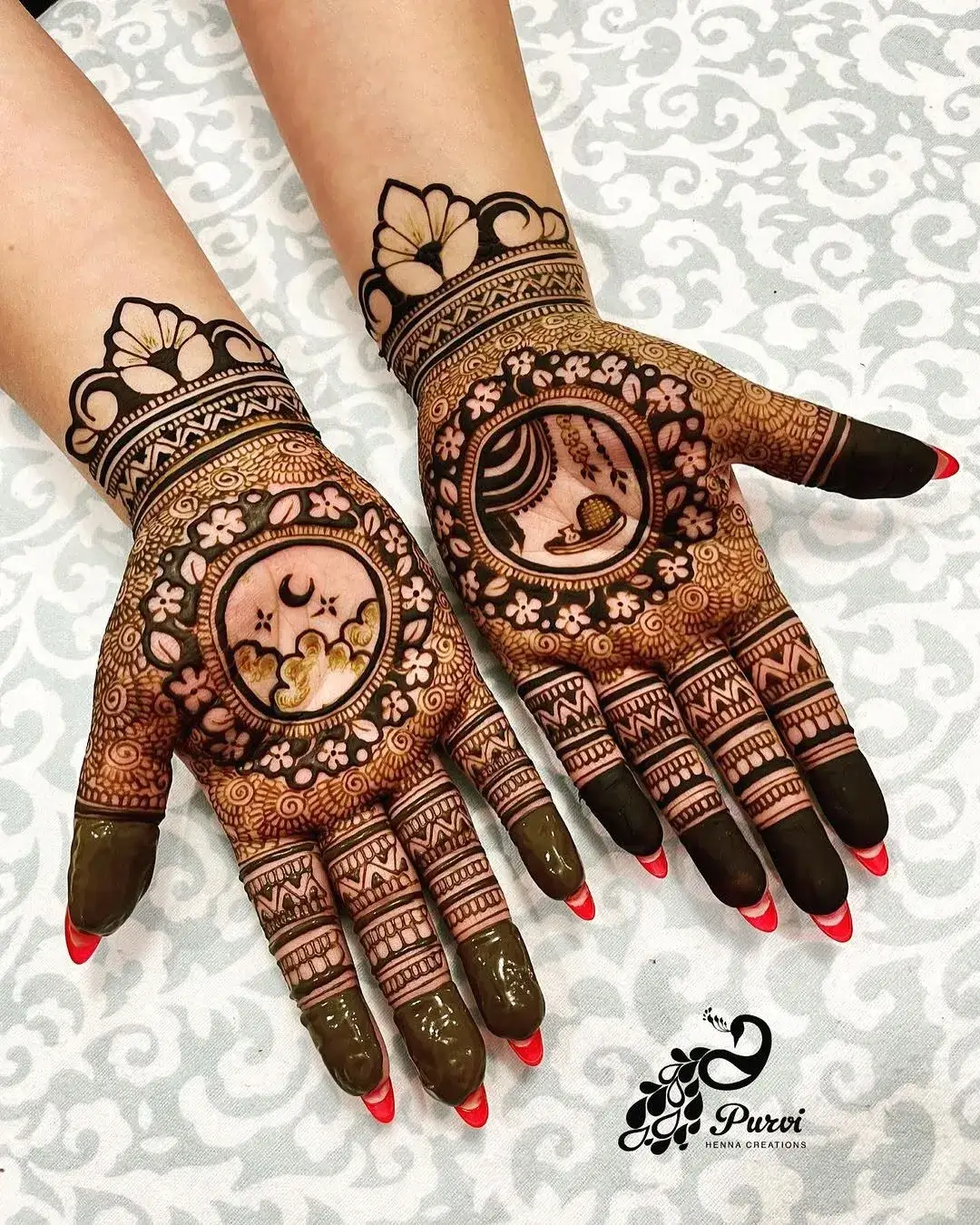
Engagement and Sangeet
These events call for something festive but faster to apply. A mandala with a wrist cuff, or a jaali fill without a large centerpiece, gives a finished look without the multi-hour sitting a full bridal design needs.
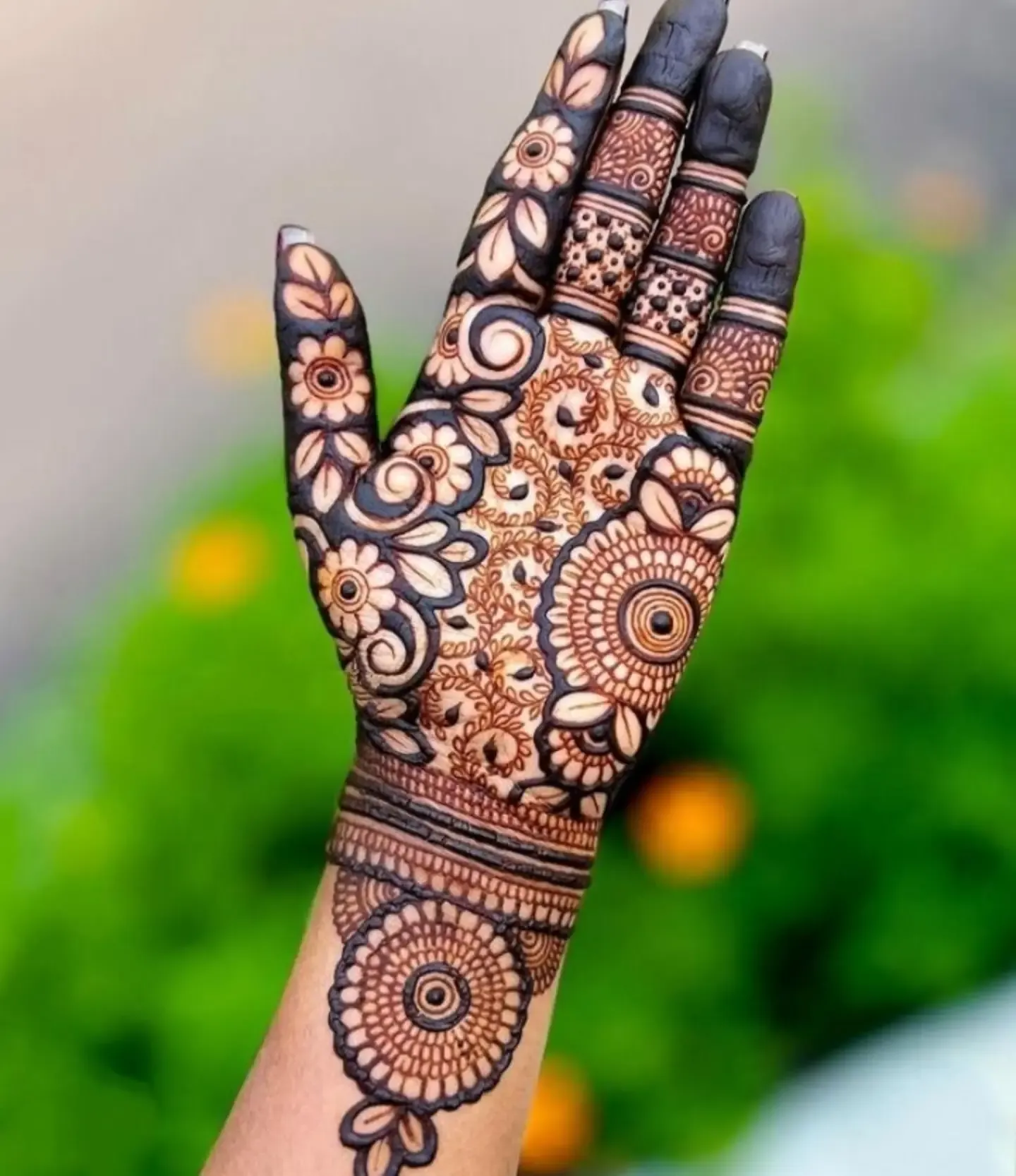
Eid
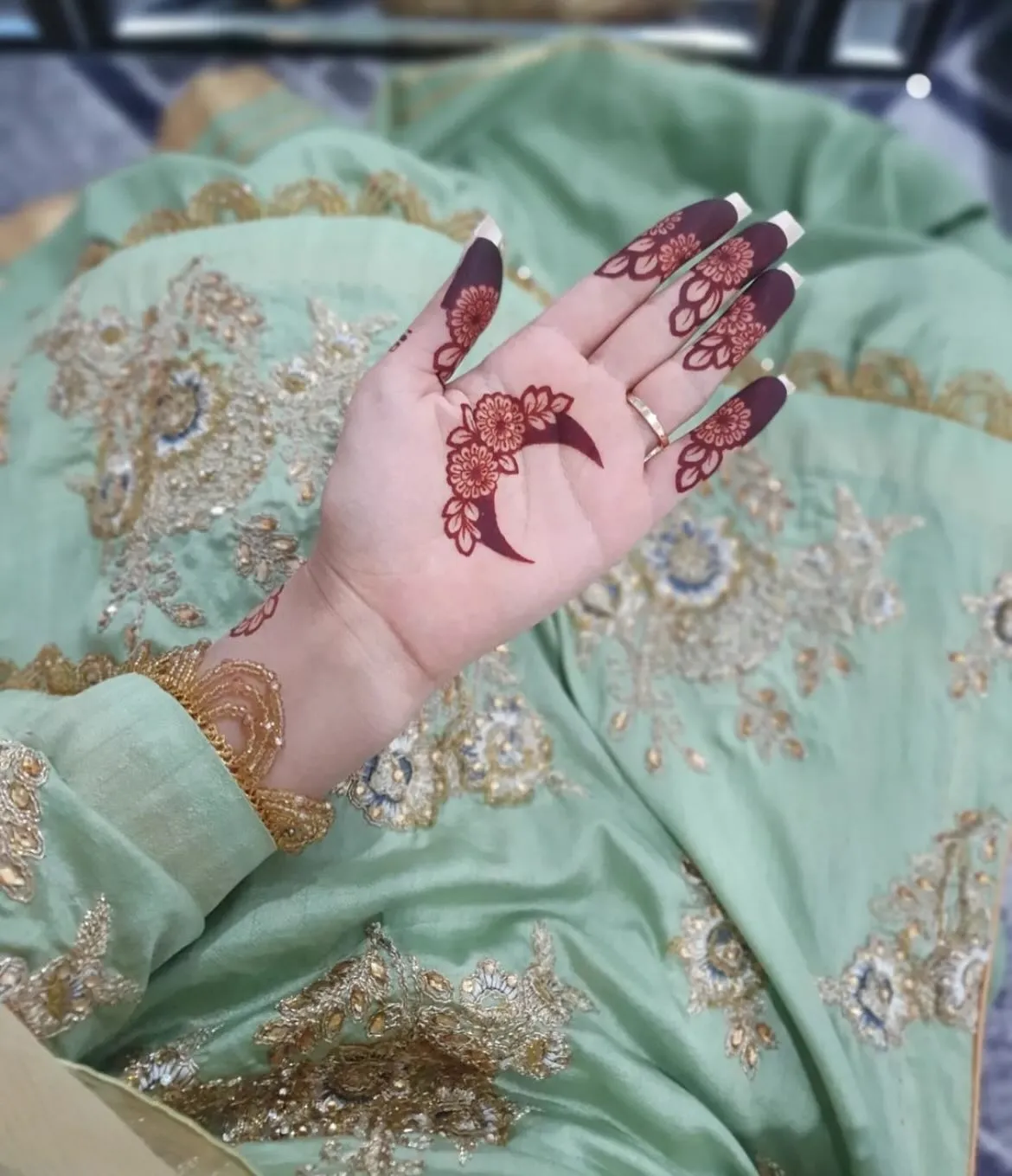
Eid mehndi tends to favor speed, since many people get it done the night before. Arabic-style florals and crescent moon motifs are common, applied with bold outlines and open space rather than dense fill.
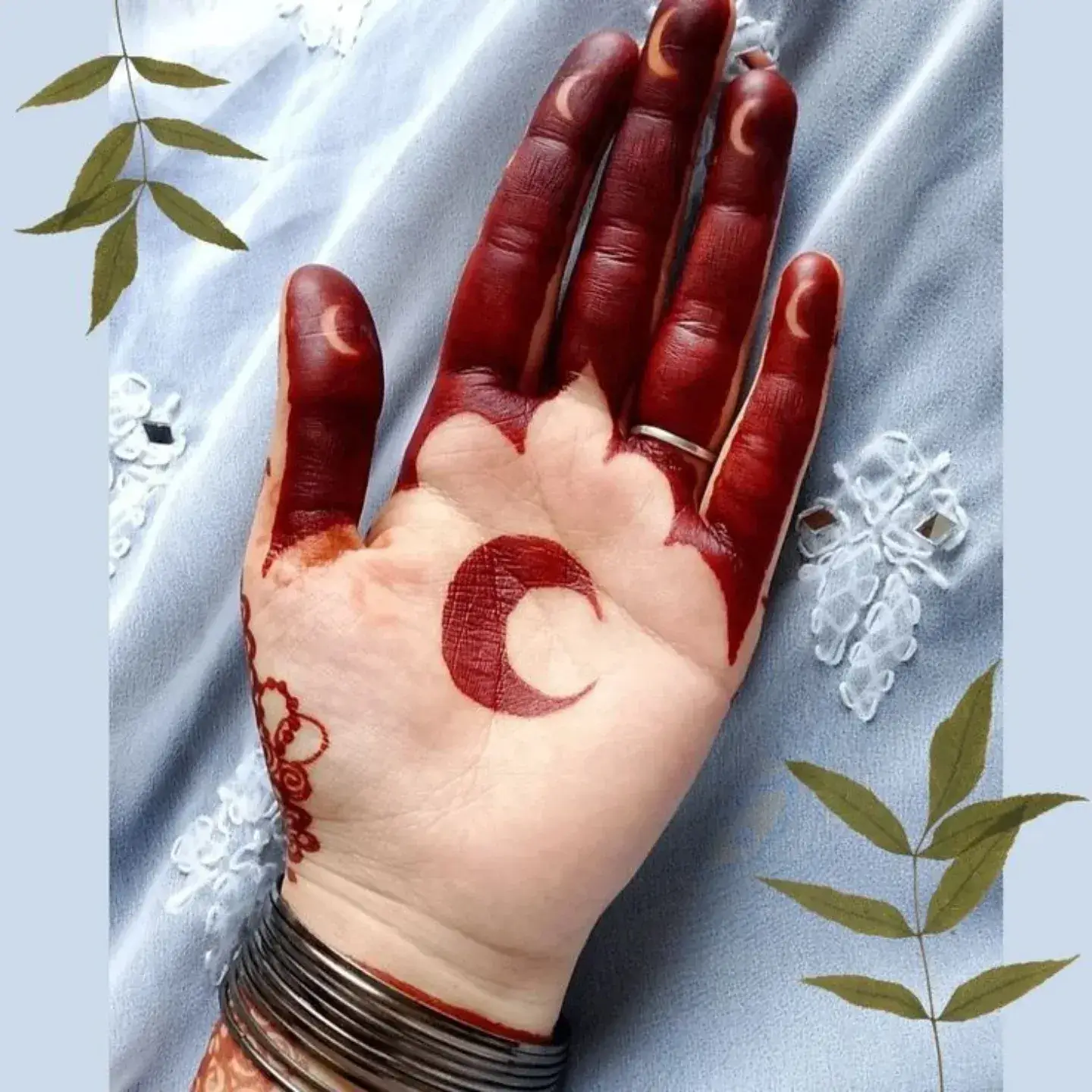
What Makes a Mehndi Design “Royal”?
A royal design has four consistent parts. A central focal point, usually a mandala, lotus, or jharokha arch. Signature motifs like peacocks and lotus flowers, symbols of grace in South Asian art for centuries. Jaali, a fine net shading that gives skin a jewelry-like texture. And deliberate negative space, clean skin left on purpose around the motifs, often finished with a wrist cuff. All four together make a design read as royal, whether it covers a small area or the full palm.
Royal Front Hand Mehndi Styles Compared
| Style | Best For | Coverage | Time |
| Bridal Heavy | Weddings | Full palm to forearm | Several hours |
| Minimalist Royal | Engagements, Eid | Central motif, open space | Under an hour |
| Indo-Arabic Fusion | Sangeet, receptions | Diagonal trail | About an hour |
| Architectural Heritage | Heritage weddings | Structured panels | Two to three hours |
Bridal Heavy often hides personal details like a wedding date. Minimalist Royal keeps all four core elements but scales them to one centerpiece. Indo-Arabic Fusion pairs Arabic-style bold outlines with Indian jaali fill. Architectural Heritage organizes the palm into sections using arches and panels instead of a continuous vine.
How to Get a Dark, Long-Lasting Stain
Fresh mehndi looks orange right after the paste comes off. That’s normal. The color darkens over the next day or two as it reacts with air, eventually settling into a deep reddish-brown.
A few steps help that process along:
- Keep the paste on longer. Leave it on for at least six hours, ideally overnight, before scraping it off.
- Seal it while it dries. Dab on a mix of lemon juice and sugar once the paste has dried but is still on the skin. This keeps it from cracking off too early.
- Avoid water for the first day. Scrape the dried paste off with a card or a bit of oil instead of washing it off. Water right after removal can wash away color before it fully sets.
- Add gentle warmth. Some people hold their hands near roasted cloves or a warm surface, since heat can help the color develop faster.
- Seal with oil. A light coat of mustard oil or a similar oil on the fresh stain can help protect it while the color deepens over the next 24 to 48 hours.
None of this changes the final shade dramatically. It mostly protects the color that’s already forming, so patience during the first day matters more than any single trick.
Is Henna only for Muslims?
No. Mehndi is used across many communities and religions, including Hindu, Sikh, and Muslim traditions, and it appears in weddings and festivals throughout South Asia, North Africa, and the Middle East. As documented in a comprehensive global study by The Natural History Museum, henna serves as a universal symbol of joy across diverse faiths, including Islam, Hinduism, Sikhism, Buddhism, and Judaism. Its artistic and social practices are celebrated globally as a deeply rooted tradition that transcends religious and cultural groups, bringing communities together during major life milestones and celebrations. It isn’t tied to one religion.
Conclusion
Royal front hand mehndi comes down to four things: a clear focal point, real motifs like peacocks or lotuses, jaali shading, and space left open on purpose. Simple mehndi designs use the same building blocks, just fewer of them.
Pick a style that matches your event and your hand shape, not just what looks good in a photo. And whatever design you choose, give the color time to darken before you judge the final shade.

Frequently Asked Questions
How long does a royal front hand mehndi design take to apply?
It depends on the density. A minimalist royal design with one central motif can take under an hour. A full bridal design with heavy jaali work and forearm coverage can take several hours to complete.
What’s the difference between Arabic and royal Indian mehndi?
Arabic mehndi uses bold outlines, large florals, and generous open space, so it applies faster and reads well from a distance. Royal Indian mehndi relies on finer detailing, jaali shading, and motifs like peacocks and lotuses, which take more time but reward a closer look.
Which mehndi design is simple?
A simple design uses one motif or a thin trail with most of the hand left bare. A single lotus, a bare wrist band, or a small mandala without extra fill all count as simple, regardless of whether the motif is also used in denser, royal-style designs.
What are the latest mehndi designs for 2026?
Current trends lean toward personalized details worked into the pattern, such as hidden names or dates, along with a mix of dense motifs and deliberate negative space rather than covering the entire hand. Fingertip detailing and clean wrist cuffs are also common, since they photograph well in close-up shots.